

Live bacteria are the core component of a bio-organic fertilizer production line, making the process highly sensitive to temperature, moisture, and mechanical force. Improper handling during the crushing stage often acts as the primary “killer” of these live bacteria. The half-wet material crusher is the key piece of equipment for solving this challenge.
Fermented organic materials typically have a moisture content of 20%–40%; they are highly viscous, prone to clumping, and already inoculated with functional bacteria. High-speed impact from hammer or chain fertilizer crushers generates significant heat—sometimes exceeding 60°C locally—which is sufficient to deactivate most live bacteria. Furthermore, wet materials tend to clog screens, leading to frequent shutdowns and an increased risk of contamination by unwanted microbes.
The half-wet crusher employs a screenless design, relying on repeated impact and shearing from high-speed hammers or chains. Materials collide and rub against each other within the crushing chamber, discharging only after reaching the desired fineness. Even wet materials with 20%–40% moisture pass through smoothly without clogging or sticking. The temperature rise during crushing is minimal—keeping the material only slightly above ambient temperature—thereby avoiding thermal damage to functional bacteria and ensuring a much higher survival rate compared to conventional methods.
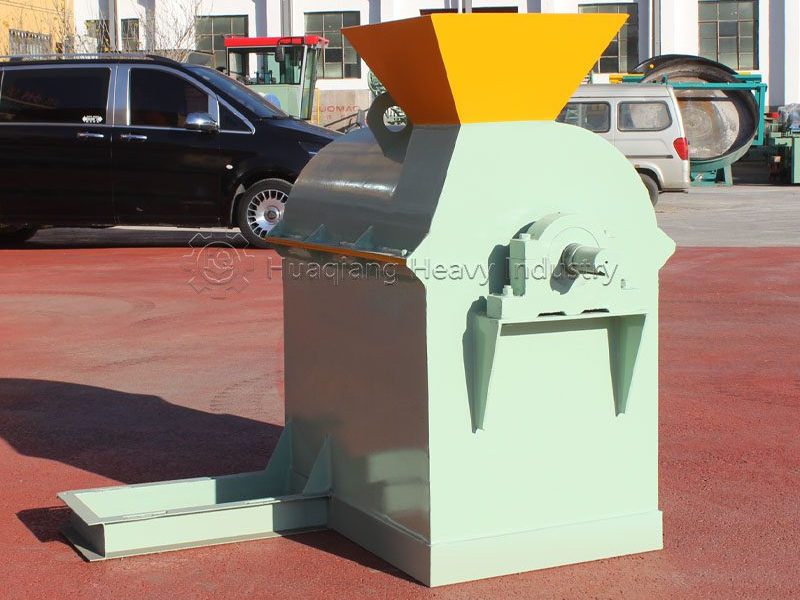
Within the production line, this crusher operates after fermentation and inoculation but before granulation. It breaks down clumps to a fineness of 60–200 mesh and cuts long fibers, providing uniform powdered material for disc or stirring-tooth granulators. Inadequate crushing leaves coarse particles and long fibers that disrupt the material curtain, resulting in poor granule strength, high recycle rates, and uneven distribution of live bacteria.
When selecting equipment, the processing capacity should ideally exceed that of the granulator, and a buffer hopper should be included. A brief aging period after crushing allows moisture to distribute evenly before the material enters the granulation stage.
Although the half-wet material crusher appears to be merely an intermediate step, it plays a critical role in protecting live bacteria and ensuring smooth material flow. Choosing the right crusher guarantees stable live bacteria counts and consistent granule quality across the entire production line.