

Roller press granulator production lines and NPK fertilizer production lines represent two distinct process routes; each comprises a complete chain of equipment, forming a self-contained system that spans everything from raw material processing to final product packaging.
NPK fertilizer production lines typically utilize a wet granulation process. Centered around a rotary drum or pan granulator, raw materials are crushed, metered, and mixed before being moistened with steam or water. They then roll and agglomerate into spheres within the granulator, followed by drying, cooling, and screening to yield the final product. Characterized by high capacity and the production of smooth, round granules, this method is suitable for the large-scale, continuous production of high-, medium-, and low-concentration compound fertilizers and represents the mainstream configuration in the domestic compound fertilizer industry.
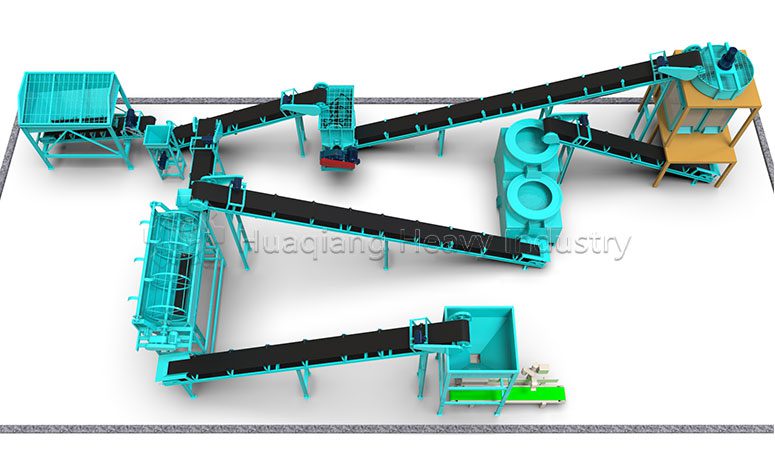
In contrast, roller press granulator production lines employ a dry forming process. Centered around a twin-roll press, dry powder materials are compressed into sheets under high pressure and subsequently crushed, granulated, and screened to produce the final particles. The entire process requires neither water nor external heat, eliminating the need for drying and cooling stages; this results in a shorter equipment chain and lower investment and energy consumption. This method is ideal for formulations with low moisture content or high heat sensitivity, or for products requiring high density.
The core difference between the two lines lies in their forming principles: the wet method relies on liquid-phase bridging and rolling agglomeration, whereas the dry method relies on mechanical high-pressure compaction. This leads to different application scopes—the wet method is suited for high-capacity production of conventional compound fertilizers, while the dry method is better suited for specialized products such as high-nitrogen/high-potassium fertilizers, water-soluble fertilizer masterbatches, and cores for slow- or controlled-release fertilizer coatings.
Selecting the right line requires a comprehensive assessment of raw material characteristics, product positioning, production capacity, and investment costs. If raw materials are dry, the formulation is heat-sensitive, and the scale is small to medium, a roller press line is preferable. Conversely, if raw materials have moderate moisture content, the product is conventional, and high capacity is the goal, an NPK wet granulation line is more suitable. Both production lines have their own distinct roles, and choosing the right route is far more important than rushing into a project blindly.