

Disc granulation production lines are widely used in the fertilizer industry. Their primary strength lies not in achieving the highest single-unit capacity or the most advanced automation, but rather in their “flexibility” regarding raw materials and process requirements.
High tolerance for material moisture content. Fermented organic materials typically have a moisture content of 20%–30%; processes like extrusion or rotary drum granulation often require pre-drying or precise moisture adjustment. Disc granulation technology, which relies on the natural rolling motion of materials to form granules, accommodates a broader moisture range. When combined with semi-wet crushing and aging/conditioning, it can process wet, undried materials directly—eliminating energy-intensive pre-drying steps and reducing operational costs.
A gentle forming process, ideal for heat-sensitive materials. Inside the disc, materials aggregate into granules through centrifugal force, friction, and gravity, without the introduction of high-temperature steam or high pressure. The material temperature remains only slightly above ambient, making the process particularly well-suited for formulations containing functional microbes or active organic substances, as it prevents the deactivation of these key components.
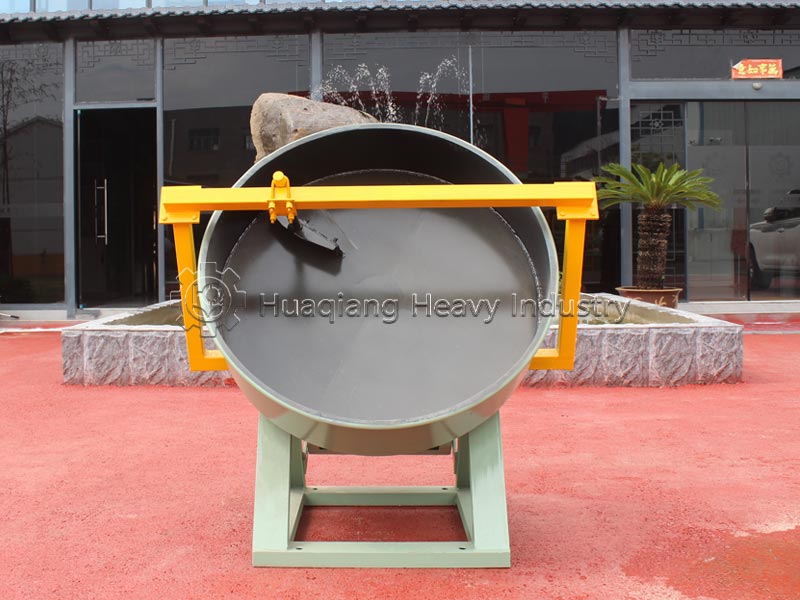
Simple equipment structure and intuitive operation. The core parameters—disc inclination angle, rotational speed, and feed rate—are easy to manage. Operators can assess granulation progress by observing the “curtain” of material within the disc; adjusting the inclination angle alters the residence time, while changing the rotational speed controls granule size. Switching between different formulations requires no mold changes, and the equipment is easy to clean, making it highly suitable for multi-product, small-to-medium batch production.
Uniform, spherical granules with high commercial appeal. As materials roll continuously within the disc, their surfaces are repeatedly compacted and smoothed, resulting in excellent sphericity and a consistent appearance—enhancing the marketability of the finished fertilizer. Oversized or off-spec granules can be crushed and returned to the disc for reprocessing, ensuring efficient material utilization and minimal waste.
Economical configuration with a low barrier to entry. Since there is no need for steam boilers or complex drying systems, both the initial capital investment and the required footprint are lower than those of rotary drum granulation production lines with equivalent capacity. With modest requirements for facility infrastructure and power supply, these lines are well-suited for small-to-medium-sized organic fertilizer plants.
For operations involving small-to-medium scales, diverse product ranges, or high-moisture raw materials, the advantages of a disc granulation line are often more practical than the pursuit of maximum single-unit capacity.