

Even for organic fertilizer production lines with the same 5-ton-per-hour capacity, configuration plans can vary drastically. The root cause lies not in the capacity figure itself, but in the product form and the process route.
There is a significant difference in configuration between powder and granular lines. For powder fertilizer, the line requires only a fermentation turner, a half-wet material crusher, a screener, and a packaging machine—a short process chain with low investment. Producing granular fertilizer, however, necessitates the addition of a granulator, dryer, cooler, and screener; this often doubles the investment, pushes total power consumption above 110kW, and places higher demands on power supply stability.
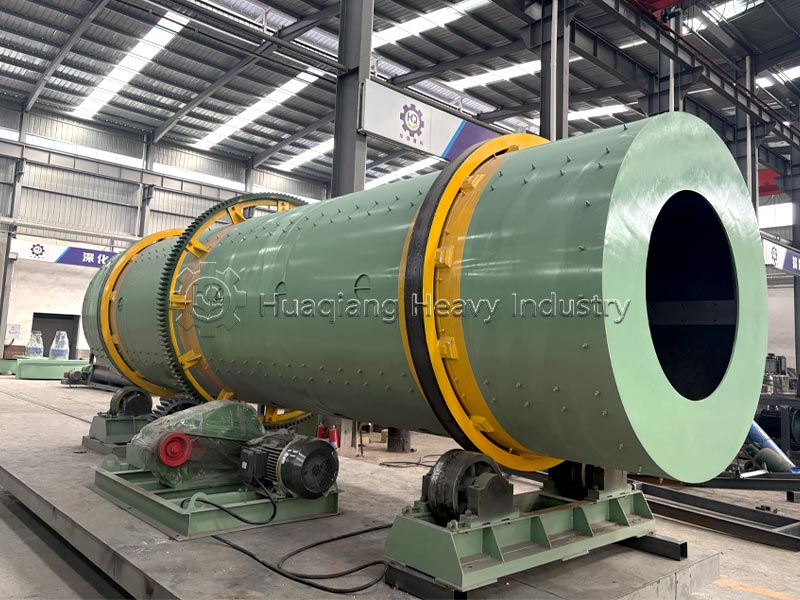
The granulation process dictates the choice of core equipment. In granular lines, the granulation stage is the key differentiator. If the feedstock consists primarily of materials with moderate stickiness—such as cow or sheep manure—a disc granulator is an economical choice; it offers high pelletization rates and produces round granules, though its single-unit capacity tops out at around 1–5t/h. For high-moisture, clumping-prone materials like chicken or pig manure, an stirring tooth-drum granulator offers better adaptability. If the goal is large-scale continuous production and high granule strength, a rotary drum granulator is the more reliable option; it handles 8–15t/h, making a 5t/h load easy to manage with stable operation.
Crushing and fermentation stages require precise matching. If a trough-type compost turning machine is used for fermentation, the theoretical throughput is approximately 4.8t/h; it is advisable to select a slightly larger model with a 20% capacity margin. For crushing, a semi-wet material crusher is ideal; a model rated for 3–6t/h is a perfect match, handling fermented materials with moisture content between 25% and 50% effectively.
Effective configuration is not merely about stacking equipment, but about precisely aligning machinery with raw materials and the desired product. One must first decide between powder and granules, then select the granulation method, and finally ensure that crushing and fermentation capacities slightly exceed the granulator’s output to guarantee smooth, continuous line operation.