

Many processing plants that already operate organic fertilizer lines are investing in new bio-organic fertilizer production lines. This is not a case of redundant construction, but rather a move driven by both product characteristics and market demand.
Standard organic fertilizer primarily provides organic matter and improves soil structure; however, it lacks active functional microbes and releases nutrients slowly, functioning more like a “soil conditioner.” Bio-organic fertilizer builds upon the organic matter base by incorporating functional microorganisms—such as nitrogen-fixing, phosphorus-solubilizing, and potassium-solubilizing bacteria, or strains that antagonize pathogens. This enables the fertilizer to improve soil while simultaneously promoting growth and preventing disease, resulting in a more comprehensive fertilizing effect. Growers observe increased yields and higher market prices, naturally leading to greater profit margins.
From a market perspective, demand for bio-organic fertilizer is rising rapidly in regions growing cash crops and in green agriculture zones. Standard organic fertilizers suffer from severe product homogenization and fierce price competition; in contrast, bio-organic fertilizers involve higher technical barriers and offer distinct differentiation, making it easier to command a brand premium. Relying solely on existing production lines risks falling behind in the next wave of competition.
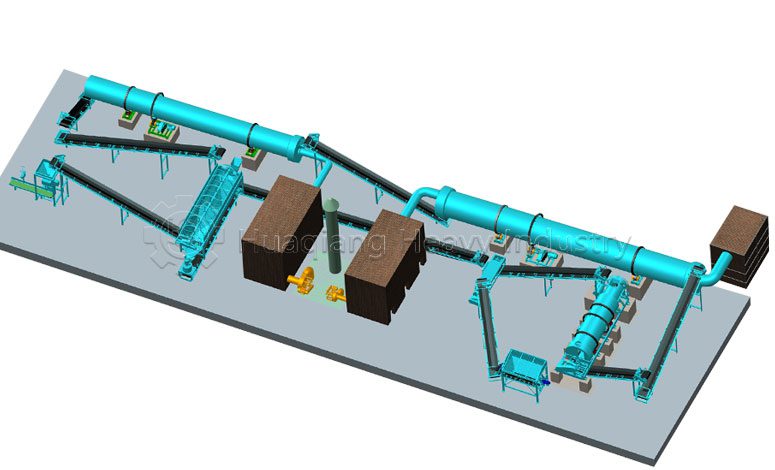
Crucially, much of the equipment from the original organic fertilizer production line—such as fermentation turners, crushing and screening units, and granulation and drying systems—can be reused. Establishing a bio-organic fertilizer line primarily requires adding capabilities for microbial inoculation, low-temperature drying, and sanitary packaging, making the investment threshold far lower than building a new plant from scratch.
Therefore, adding a bio-organic fertilizer line represents a value-driven transition from “selling organic matter” to “selling live microbes plus organic matter,” allowing enterprises to capture both the mass market and the high-end market from a single facility.