

The new type stirring tooth-drum granulator excels at directly pelletizing high-moisture materials (typically with 20%–40% moisture content), which requires the feedstock to be loose, uniform, and free of large clumps. As the core equipment of the fermentation stage, the type of turner selected directly impacts granulation performance.
Trough-type compost turner: A stable choice for medium-to-large production lines. Materials are turned within fixed concrete channels, ensuring consistent moisture and temperature; this provides a steady supply of material with uniform moisture content to the granulator. It is ideal for continuous production projects with an annual output exceeding 10,000 tons. The downside is the need to construct fermentation channels, resulting in a slightly higher initial investment.
Windrow compost turning machine: An economical solution for small-to-medium operations. Self-propelled or crawler-mounted units straddle the material piles, offering great site adaptability, low investment costs, and flexible mobility. While the turned material is aerated and loose, uniformity is slightly lower, requiring more frequent turning to compensate. It is suitable for production lines with annual outputs of a few thousand tons and limited budgets.
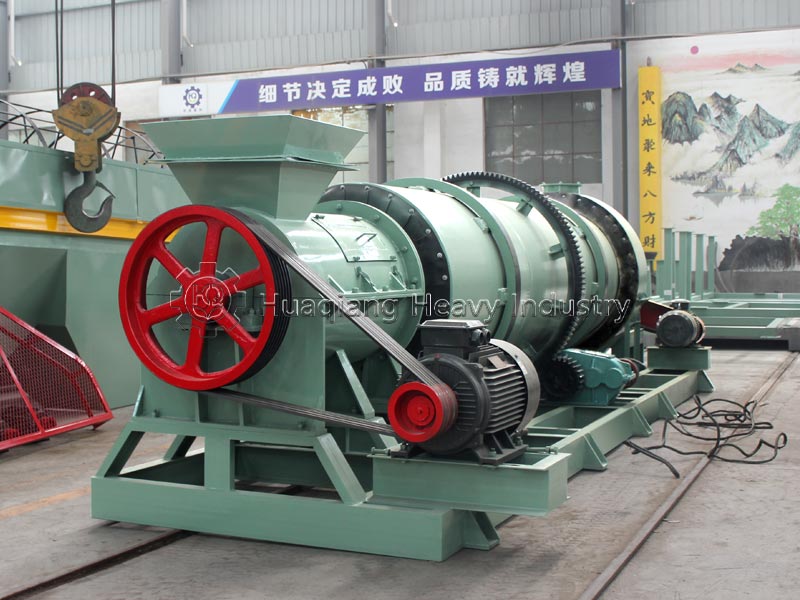
Double screws compost making machine: Specifically designed for high-moisture, high-fiber materials. The twin-screw mechanism offers powerful kneading and crushing capabilities, breaking up clumped manure and long straw to prevent large chunks from entering the granulator and causing wall adhesion or uneven granules. It is particularly well-suited for formulations with high straw content and elevated moisture levels, significantly reducing the risk of clogging.
In summary, the requirements for a turner paired with the new type stirring tooth-drum granulator can be summarized as “Uniformity, Crushing, and Stability”—uniform moisture, thorough crushing, and stable material supply. Trough-type turners prioritize scale; windrow turners prioritize investment cost; and double-screw turners prioritize material characteristics. When selecting equipment, consider raw material properties and production targets first, followed by turning uniformity and crushing capability, to ensure the fermentation stage effectively supports the granulation stage.