

Unconstrained by fixed rails, self-propelled compost turning machines utilize their own propulsion systems to move freely between windrows. Their high mobility—allowing them to operate wherever turning is required—makes them versatile tools for a wide range of composting scenarios.
Manure management areas at small-to-medium-sized livestock farms. At pig, poultry, or sheep farms, daily-cleared manure mixed with bedding material is piled into windrows; a self-propelled compost turning machine can drive directly between these rows to perform its work. With a compact design and a small turning radius, it is ideal for handling scattered piles near barns or in the corners of a farm, eliminating the need for dedicated composting bays.
Municipal sludge and green waste composting facilities. Dewatered sludge (which is highly viscous) and fibrous garden trimmings are often mixed and piled into windrows. The drum or auger mechanism of a self-propelled unit can simultaneously break up sludge clumps and shred branches, handling both mixing and turning in a single pass—a perfect solution for municipal projects with expansive sites and diverse material streams.
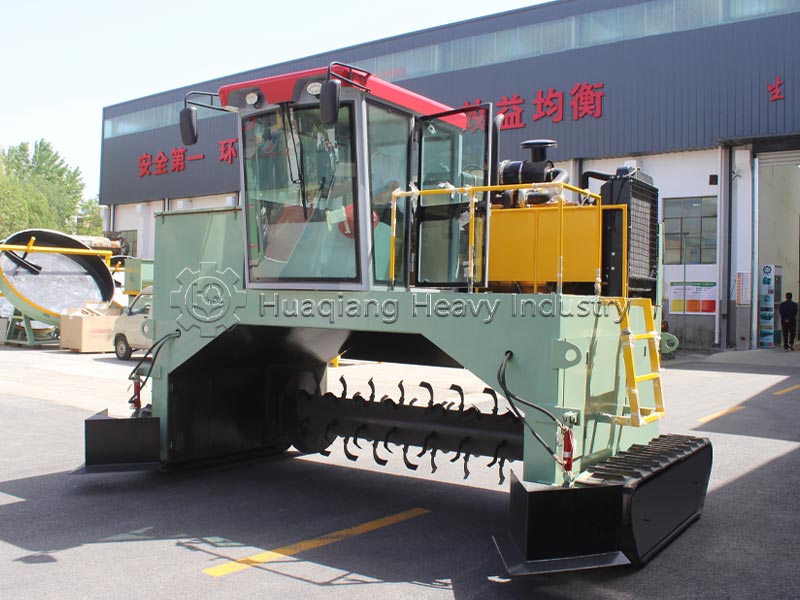
Decentralized composting sites for rural crop residues and domestic waste. In townships or villages, composting often takes place in open-air windrows rather than fixed bays. A self-propelled machine can travel along rural roads, moving from one site to the next, which significantly reduces the equipment investment required for multi-site operations.
Fermentation of spent mushroom substrate. Spent mushroom substrate typically has high moisture content and a loose structure, meaning the piles should not be too deep. A self-propelled turner can perform shallow, low-speed turning, preventing over-compaction and ensuring the pile remains well-aerated.
Emergency organic waste management. In situations requiring the on-site, harmless composting of deceased livestock or contaminated organic matter, a self-propelled compost turning machine can quickly reach the location. By incorporating auxiliary materials and turning the piles to raise their temperature, it helps shorten the overall treatment cycle.
The true value of a self-propelled compost turning machine lies not in being the “largest” or “most powerful,” but in its “mobility”—it liberates composting capabilities from the confines of fixed bays, enabling flexible, windrow-based composting across diverse locations and material types. When selecting a model, focus on the undercarriage, turning/mixing depth, and ease of relocation—simply choose one that aligns with the scale of your composting operation.