

In organic fertilizer production, the stability of the fermentation process directly determines the quality of subsequent granulation and the final product. Trough-type compost turning machines, which operate on fixed rails, are increasingly being adopted by large-scale livestock farms and organic fertilizer plants. Their operational logic can be summarized as “in-trench circulation with precise temperature control.”
The working mechanism is straightforward: fermentation takes place in long, concrete trenches equipped with rails along both sides, over which the compost turning machine straddles and travels longitudinally. Its core component is a high-speed rotating drum that cuts into the material layer, lifting, breaking up, and throwing the material backward. A single pass along the trench turns the entire volume; the turning depth can reach 0.8–1.5 meters, with the thickness of the material layer remaining uniform and controllable.
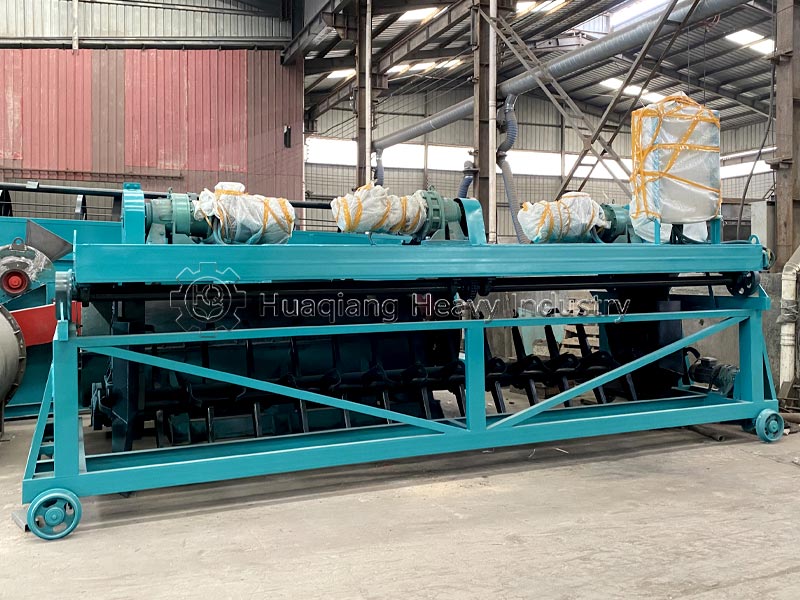
These machines are best suited for continuous, large-scale operations. Material is fed in at one end of the trench, and the turner advances toward the discharge end at a set frequency—typically turning the material once every one to two days. Because the trench structure is fixed and parameters like turning depth and travel speed can be precisely calibrated, the process remains unaffected by site conditions or weather. This ensures more uniform temperature and oxygen distribution within the trench, resulting in a stable fermentation cycle of 15–20 days.
Key operational points include: adjusting the turning frequency based on temperature (once daily during the initial heating phase, more frequently during the high-temperature phase, and less frequently during the maturation phase); keeping the material layer thickness within a manageable limit—usually under 1.2 meters—to ensure the drum can penetrate to the very bottom; and utilizing the turner to push the finished material toward the end of the trench, facilitating the transition to subsequent processing stages like crushing or granulation.
The primary advantages are a high degree of automation, uniform mixing, and a controllable environment, making these systems ideal for livestock farms with large daily manure outputs or specialized organic fertilizer plants. The main limitation is the requirement for constructed fermentation trenches and rails, which entails a higher initial investment compared to windrow-based composting methods. Nevertheless, for enterprises seeking consistent output and standardized management, trough-type compost turning machines represent a highly viable fermentation solution.