

Roller compaction granulation is a dry forming process that requires neither water nor heat. While the equipment chain is compact, each unit performs a specific, indispensable function.
Feeding and mixing mark the starting point. Raw materials are proportioned and fed into the mixer via metering feeders; a double shaft paddle mixer or ribbon mixer blends urea, potassium salts, ammonium phosphates, and fillers, maintaining a coefficient of variation within 5%. Uneven mixing leads to nutrient fluctuations in the compacted sheets.
The fertilizer roller granulator serves as the core unit. Powdered material is compressed under high pressure between counter-rotating rollers into sheets or strips. Roller pressure, rotational speed, and roller surface profile determine sheet density and strength. Temperature control is required for heat-sensitive formulas, while wear-resistant roller surfaces are necessary for hard materials; roller surfaces often feature corrugations or dimples to improve material “bite.”
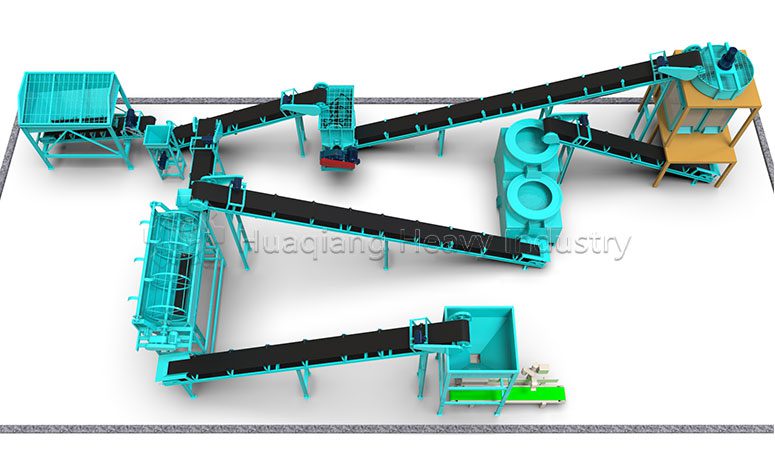
Crushing and granulating determine particle size. Compacted sheets are first broken up by a crusher and then rounded by a granulator. The granulator’s speed and screen aperture size dictate particle sphericity and specifications.
Screening and material recycling ensure a closed-loop process. A vibrating screen separates qualified product from fines and oversized particles; the latter are returned to the front end for re-compaction via a recycle conveyor, with the recycle ratio ideally controlled between 20% and 30%.
Dust removal and packaging conclude the process. Bag-type dust collectors are installed at material transfer points, and finished products are cooled before entering the packaging machine for weighing and sealing.
The essential equipment for the entire roller press granulator production line can be summarized as follows: feeders, mixer, press granulator, crusher, granulator, vibrating screen, recycle conveyor, dust collector, and packaging machine. While the compactor is the core component, auxiliary equipment is equally critical to the smooth operation of the entire line.