

In the fertilizer industry, disc granulation production lines and bio-organic fertilizer production lines represent two production systems with different market positioning and vastly different processes. The former focuses on “granule formation,” while the latter addresses “live microbes plus formation.”
Disc granulation production lines center on the disc granulator, supported by equipment for crushing, screening, drying, and cooling; the goal is to transform powdered raw materials into smooth, round granules. There are no requirements for live microbes in the raw materials, allowing for the processing of conventional organic fertilizers, compound fertilizers, and inorganic fertilizers. The process prioritizes moisture content, material fineness, and disc parameters, aiming for high granulation rates and granule strength. High-temperature drying is permissible to enhance efficiency.
Bio-organic fertilizer production lines, however, are governed by the critical requirement of maintaining “live microbe viability.” The final product must contain sufficient functional microorganisms, so the entire line is designed for low-temperature, clean, and rapid processing. Microbial strains are inoculated after fermentation; crushing must minimize heat generation; granulation occurs at ambient or low temperatures; drying temperatures are kept below 60°C; and packaging must be moisture-proof and light-shielded. While the disc granulator is often selected for its gentle forming action, it is merely one component and does not define the entire line.
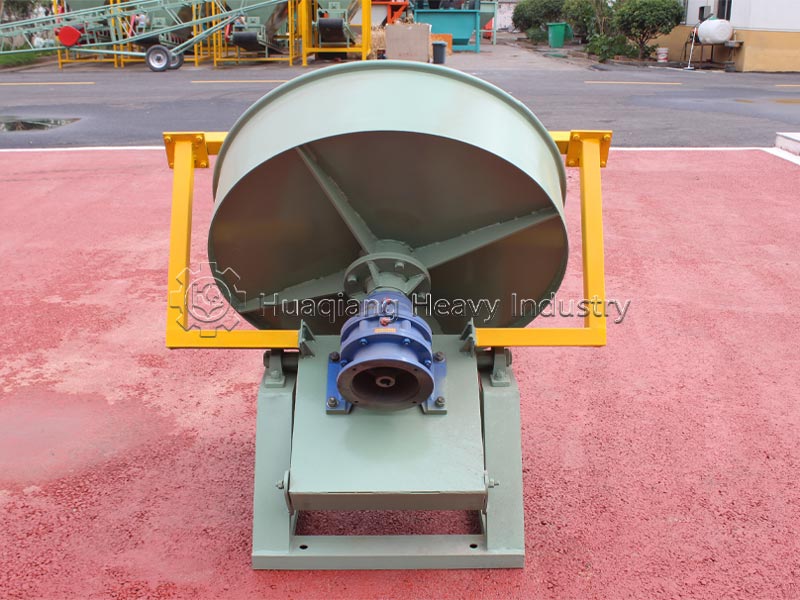
The key difference lies in priorities: disc granulation lines can tolerate high temperatures, dust, and significant mechanical force, provided the granules meet specifications; bio-organic fertilizer lines prioritize the microbes at every stage, necessitating different equipment choices, process parameters, and workshop environments. Simply converting a disc granulation line to produce bio-organic fertilizer often requires adding inoculation systems, low-temperature drying capabilities, and clean packaging facilities, as well as adjusting crushing and granulation parameters; otherwise, the live microbe count is unlikely to meet standards.
In short, disc granulation production lines prioritize “granule formation,” whereas bio-organic fertilizer production lines prioritize “microbial activity.” They serve different product positioning needs and are not interchangeable.