

The rotary drum granulator is a key piece of equipment for large-scale, continuous production in the compound fertilizer industry. Its main body consists of a slightly inclined rotating cylinder; materials enter at the high end and undergo a transformation from powder to granules, a process relying on the precise coordination of the cylinder’s rotation, internal structures, and liquid-phase media.
Upon entering the cylinder, the material is lifted to a certain height by internal lifting flights and then cascades down in a curtain-like pattern. Steam and water are atomized and sprayed into the drum, making full contact with the tumbling powder. The steam provides heat and dissolves some salts, creating liquid bridges on the particle surfaces that cause adjacent powder particles to bond and form nuclei. As the cylinder continues to rotate, the small granules are compacted and grow, gradually becoming round and dense.
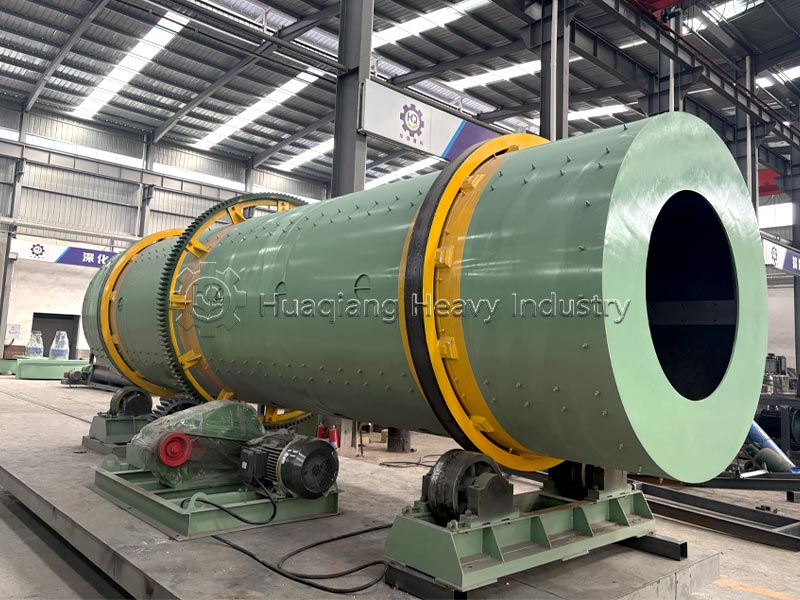
Retaining rings or overflow rings are installed inside the cylinder to control the material bed thickness and residence time. Material moves slowly from the high end to the low end, remaining inside for a period ranging from several minutes to over ten minutes. Rotation speed, inclination angle, steam pressure, and feed rate are the four core operating parameters. If the rotation speed is too high, the material falls too violently, reducing the granulation rate; if it is too slow, agitation is insufficient, making the material prone to sticking to the walls and forming rings. Unstable steam pressure leads to inconsistent particle sizes.
Common operational issues include wall adhesion—often caused by excessive moisture or steam—and ring formation, which is associated with an overly thick material bed or temperature fluctuations. Operators must maintain a uniform material curtain and continuous feeding, while also regularly cleaning the cylinder walls. At the discharge end, the granules require drying, cooling, and screening; only qualified products are packaged and stored.
Rotary drum granulators are renowned for continuous operation, high capacity, and the production of round granules, with single-unit hourly outputs reaching tens of tons. Rather than aiming for instantaneous formation, the process allows the material to complete a rhythmic journey within the cylinder, ultimately emerging as uniform granules.