

Flat die pelleting machines form pellets by using pressure rollers to force powdered material into die holes; consequently, the input material must meet three strict requirements: uniform fineness, moderate moisture content, and an absence of long, entangling fibers. The suitability of a cage fertilizer crusher for this feeding role depends on how well it addresses these three criteria.
Regarding fineness, flat-die holes typically range from 4 to 8 mm in diameter; if the powder contains coarse particles exceeding 2 mm or long fibers, the die holes may clog, causing the pressure rollers to slip. Cage fertilizer crushers operate without screens, relying on high-speed impacts from cage bars to pulverize material to a fineness of 60–200 mesh, fully meeting output requirements. They are particularly effective with fibrous materials like crop stalks and spent mushroom substrate, as they can chop long fibers to prevent roller entanglement—an advantage that chain or hammer mills struggle to match.
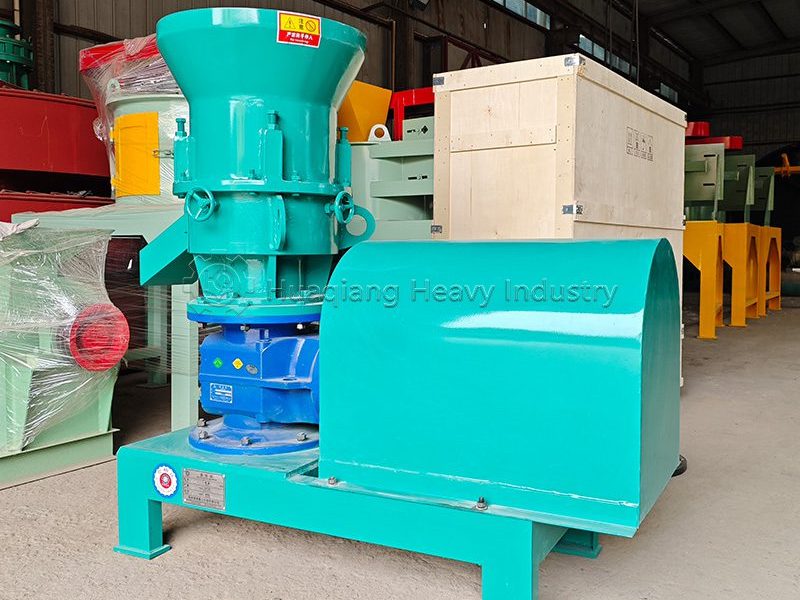
Regarding moisture, cage fertilizer crushers excel at processing damp, soft materials with moisture contents of 20%–30%, whereas the optimal moisture range for flat die pelleting machine is typically 15%–20%. If the crusher’s output is too wet, the material tends to stick to the die or produce loose pellets; if too dry, forming becomes difficult and excessive dust is generated. Therefore, an intermediate aging or conditioning step is often required to ensure moisture permeates the material evenly, achieving a consistency where it holds its shape when squeezed by hand but does not crumble upon release.
Regarding production capacity, flat die pelleting machine is a continuous extrusion process, so any interruption in the feed supply directly impacts output. Ideally, the fertilizer crusher’s capacity should slightly exceed that of the pellet mill, and a buffer hopper should be installed to ensure a steady supply.
In summary, cage fertilizer crushers and flat die pelleting machines are highly compatible in terms of output fineness, though moisture levels require intermediate adjustment and capacities must be reasonably matched. With proper integration, this combination can reliably transform high-moisture organic waste into uniform cylindrical pellets.