

In an organic fertilizer production line, the disc granulator plays the leading role in shaping, while the cage crusher serves as the preparatory stage. The synergy between the two directly determines granule roundness and overall production efficiency.
The cage crusher is specifically designed for high-moisture organic materials. Fermented manure, straw, and fungal residues often form clumps and contain 20%–30% moisture. While traditional equipment tends to clog when handling wet materials, the cage crusher utilizes a rotor with multiple concentric cage bars; it pulverizes material through high-speed impact without the need for screens. It produces fine material (60–200 mesh) without sticking or clogging. This perfectly meets the disc granulator’s requirements for feed material: uniform fineness and an absence of long, tangled fibers. If long straw or hard lumps are present, the material curtain is disrupted, leading to lower pelletization rates and rough granules.
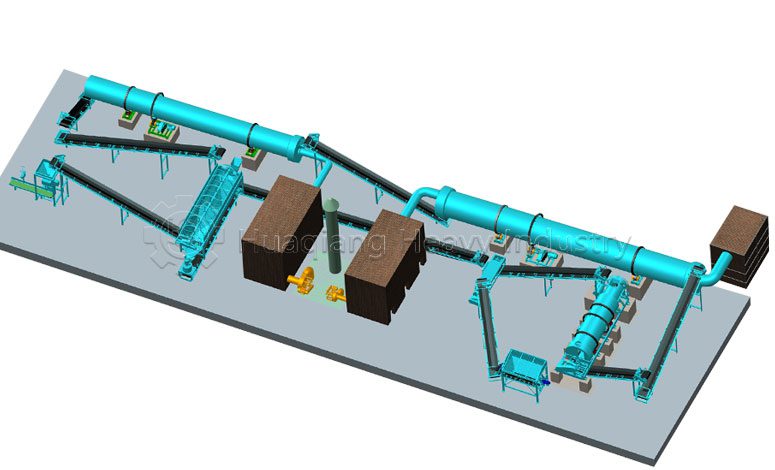
The disc granulator relies on an inclined, rotating disc surface, allowing powdered material to naturally roll into spheres under the influence of centrifugal force, friction, and gravity. It is sensitive to material fineness, with optimal moisture content for shaping typically ranging from 15%–25%. Material discharged from the cage crusher tends to be on the wetter side; if fed directly into the disc, it may stick to the walls or result in loose granules. Conversely, if the material is too dry, it generates excessive dust and is difficult to pelletize. Therefore, a conditioning or aging step is often required between the two stages to ensure moisture permeates evenly until the material can form a clump when squeezed by hand but does not crumble upon release.
Regarding capacity, the cage fertilizer crusher’s throughput should ideally exceed that of the disc granulator, supported by a buffer hopper to ensure continuous feeding. Oversized particles or “returns” from the disc granulator can be sent back to the cage crusher for re-pulverization and mixed with fresh material before re-entering the disc, creating a closed-loop system with virtually no waste discharge.
The advantage of this combination is that the cage crusher enables the production line to process wet, fermented material directly—without prior drying—thereby significantly reducing investment costs and energy consumption. For small and medium-sized organic fertilizer plants, this seamless integration of pulverization and granulation offers a practical solution for reliably transforming waste materials into uniform, rounded granules.