

Roller press granulator production lines are widely used in the processing of dry powder fertilizers such as compound fertilizers and blended fertilizers due to their advantages of no drying required, high molding efficiency, and strong material adaptability. The actual capacity of the equipment is a core reference for plant selection, and its output range is quite wide.
Depending on the equipment configuration, production line capacities are clearly categorized. Small, simple production lines have an hourly output of 1-3 tons and a daily output of 8-25 tons, suitable for small-scale production scenarios such as agricultural cooperatives and small processing plants. Medium-sized standard production lines are the mainstream in the market, with a stable hourly output of 3-8 tons, meeting the needs of regular large-scale production. Large, fully automatic, high-configuration production lines can reach an hourly output of 8-15 tons, suitable for large-scale fertilizer enterprises with large-volume processing.
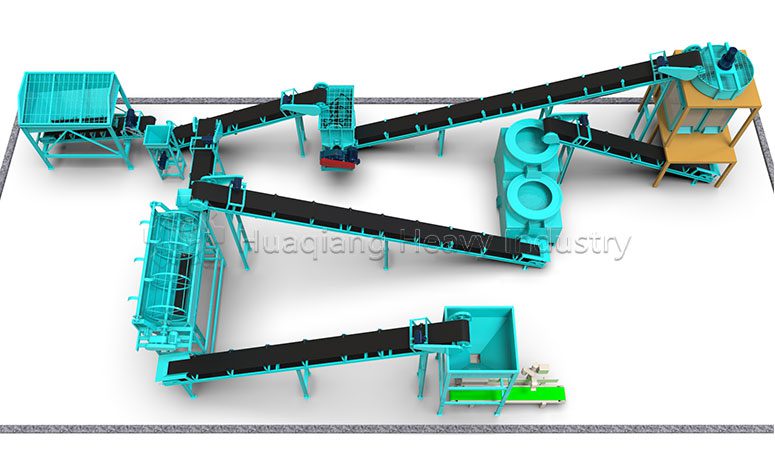
The roller press fertilizer dry granulation process is simplified, eliminating the need for drying and cooling equipment. The production process is short, with fewer downtime due to malfunctions, longer effective operating time, and stronger capacity stability. Under the premise of standardized material ratios and good equipment conditions, continuous and stable production can be achieved throughout the day.
In actual production, output fluctuates to some extent. Dry, fine powder materials form quickly and have high capacity, while materials with high moisture content and a hard texture will reduce granulation efficiency. At the same time, the capacity matching of supporting equipment such as crushing and mixing equipment also directly affects the final output of the entire production line.
In summary, roller press granulator production lines have a wide capacity coverage and are suitable for a wide range of scenarios, catering to both small-scale processing and large-scale mass production needs. With its stable operating performance and high cost-effectiveness, it has become the mainstream production equipment for dry granulation of dry fertilizer powder.