

Roller compaction granulation is a dry forming process that utilizes a fertilizer compaction machine to press dry powder directly into sheets, which are subsequently crushed and granulated; the entire process requires neither water nor heat. Establishing a roller compaction production line is often the optimal solution in the following scenarios.
This applies when raw materials have low moisture content and adding water is undesirable. Formulations based primarily on dry powdered materials—such as urea, potassium chloride, and monoammonium phosphate—typically have a moisture content of only 2%–5%; wet granulation would require adding water followed by drying, resulting in high energy consumption and potential nutrient loss. In contrast, the roller compaction granulation process enables shaping using the raw materials’ inherent moisture, thereby eliminating the need for humidification and drying steps.
When the formulation contains heat-sensitive components. High-nitrogen fertilizers, as well as those containing microbial agents or active organic substances, can decompose or lose activity when exposed to high temperatures. The roller-compaction process introduces no external heat source; material temperature rises only slightly due to pressure, thereby maximizing the preservation of active ingredients.
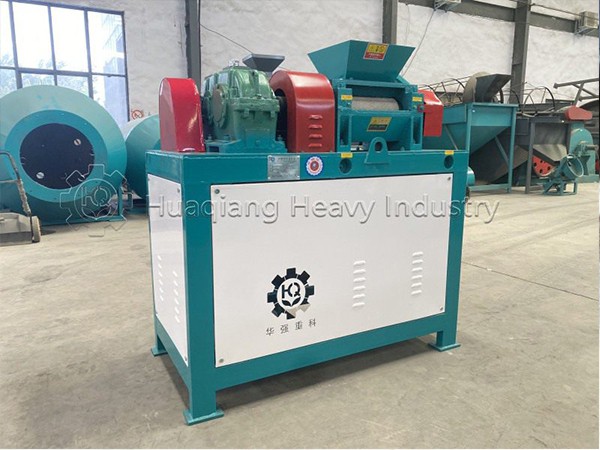
When the product requires high density and strength. Slow- and controlled-release fertilizers require dense, solid core granules prior to coating. Roller-compacted granules can achieve densities of 1.3–1.6 g/cm³ and possess compressive strength far superior to wet-granulated particles; they are less prone to breakage after coating, resulting in more stable slow-release performance.
When production capacity is small to medium and formulation switching is frequent. For production lines with an annual output of 10,000 to 50,000 tons, roller-compaction equipment offers low investment costs, a compact footprint, and flexible startup/shutdown capabilities. Granule size can be changed simply by swapping roller molds, making it ideal for multi-variety, small-batch, and made-to-order production.
When environmental regulations are strict and wastewater discharge is prohibited. The roller-compaction process operates in a fully enclosed system, generating no process wastewater. Dust emissions can meet compliance standards through simple bag-filter collection, making the process suitable for environmentally sensitive areas or factory renovation projects.
When dealing with dry raw materials, heat-sensitive formulations, high-strength product requirements, moderate production scales, and environmental constraints, a roller press granulator production line provides the precise solution: a process requiring no added water, no heat, and no waste discharge.