

The new type stirring tooth-drum granulator utilizes high-speed rotating pins to subject materials to forced shearing, kneading, and projection, continuously performing mixing, granulation, and densification within a sealed chamber; it is suitable for granulating organic fertilizers, biomass fuels, and various mineral powders. The resulting granule quality depends heavily on material properties and operating parameters.
Moisture content is fundamental to the granulation process. The equipment accommodates a wide range of moisture levels—typically 20%–40% for feed material—but levels below 15% result in insufficient adhesion, leading to loose, fragile granules, while levels above 22% tend to cause wall adhesion and clumping. In practice, the “squeeze-into-a-ball-and-crumble-upon-impact” test serves as a visual benchmark; moisture is adjusted slowly via atomized water to prevent localized over-wetting. Real-time moisture monitoring is recommended, with fluctuations controlled within ±2% to ensure batch consistency.
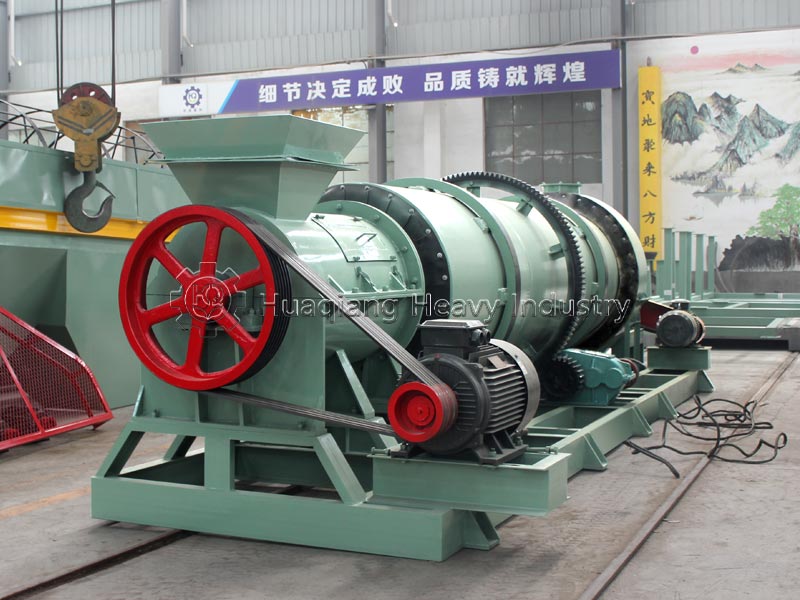
Rotational speed must be dynamically matched to raw material characteristics. The linear speed of the stirring pins typically reaches tens of meters per second; excessively low speeds result in insufficient kneading and loose granules, while excessively high speeds generate excessive centrifugal force, causing powder dispersion. Granule diameter is inversely regulated by moisture content and rotational speed: lower moisture and higher speeds yield smaller granules. For fibrous materials like straw, the main shaft speed should ideally be controlled between 280 and 320 rpm, with fine-tuning based on the material’s tumbling behavior inside the chamber and the resulting particle size distribution.
Raw material fineness directly affects granule quality. Finer materials yield higher sphericity; generally, a particle size of less than 200 mesh is required prior to granulation. If coarse particles exceed 2mm, the stirring pins struggle to knead and encapsulate them effectively, leading to internal voids and reduced strength. Therefore, uneven raw materials should undergo preliminary crushing and classification screening to ensure uniform fineness.
While forced-formation stirring tooth-drum granulation overcomes the limitations of traditional equipment, achieving uniform, dense, and high-quality granules requires precise control over moisture content, rotational speed, and material fineness.