

After the autumn harvest, the straw piled up in the fields and the livestock manure cleared from farms have long been a challenge for rural environmental management. Aerobic composting is the mainstream path to achieving waste fertilizer, and the most crucial step is the turning operation—the emergence of the double screws compost turning machine has made this process highly efficient and thorough.
The core of this equipment consists of two large, parallel, oppositely rotating helical blades. As the equipment straddles the windrow-type compost pile, both helical shafts rotate inward simultaneously, forcibly lifting the bottom layer of material and throwing it to both sides, while the surface material is drawn into the bottom, creating a three-dimensional exchange between the top and bottom, and inside and outside. This action not only breaks up clumps but also forces the interior of the pile into full contact with fresh air, continuously supplying oxygen to microorganisms and steadily raising the pile temperature to above 60°C, effectively killing pathogens and weed seeds.
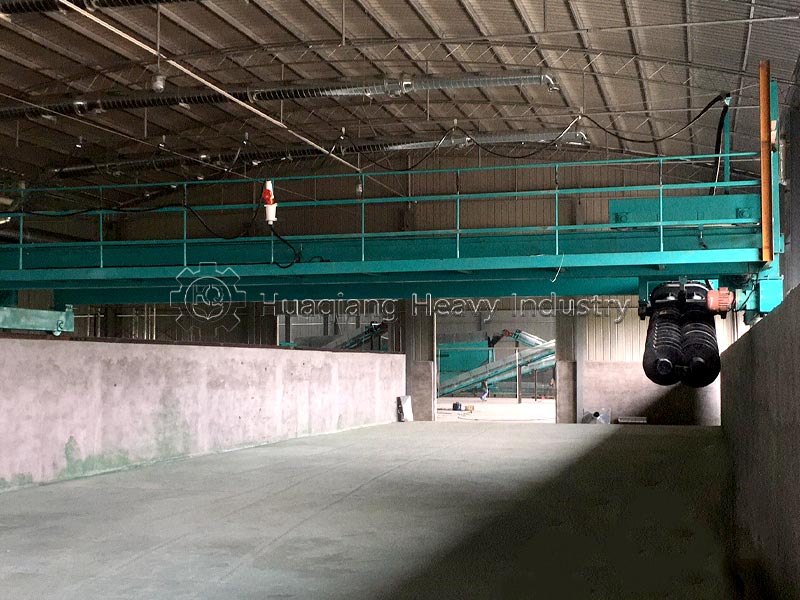
The advantage of the double screws structure lies in its “zero dead angle” design. The overlapping area of the two shafts generates a strong kneading effect, preventing even fibrous materials like straw from tangling. After turning, the pile is fluffy and uniform, with moisture evaporating simultaneously, avoiding rancidity and foul odors caused by localized anaerobic processes. The equipment can turn the entire pile in one pass, with an operating width typically 2-3 meters, a processing capacity of several hundred cubic meters per hour, and a fermentation cycle shortened to 15-20 days.
During operation, the turning frequency needs to be adjusted according to the pile temperature—once every two days during the warming period, daily during the high-temperature period, and moderately reduced during the maturation period. The pile height should be controlled below 1.2 meters, and the width should match the equipment span to ensure the spiral blades fully penetrate the bottom layer. The equipment has a built-in hydraulic lifting system, which can flexibly adjust the turning depth to adapt to different material densities.
As an agricultural waste compost turning machine, the double screws compost turner reduces manual labor intensity and improves compost quality. It is a green bridge that transforms “pollutants” into “organic fertilizer,” playing an irreplaceable role in circular agriculture.