

The roller press granulator production line is the core carrier of dry fertilizer molding technology. With its purely physical extrusion molding logic, it has formed a distinct differentiated advantage in the fertilizer production field, covering the entire chain from raw material input and production process to finished product output.
High nutrient retention is a core technological advantage. Roller press granulation is completed entirely at room temperature, achieving powder densification through mechanical pressure. It eliminates the need for high-temperature drying and liquid-phase reactions, thus fully preserving the activity of nitrogen, phosphorus, potassium, and trace elements, and avoiding the decomposition and volatilization of heat-sensitive nutrients.
No additional auxiliary materials are required, which is a significant cost advantage. The production line relies on physical pressure to achieve self-bonding of powder, eliminating the need for auxiliary raw materials such as bentonite and binders. This avoids diluting nutrient concentration with auxiliary materials, ensures the purity of the fertilizer formula, and simplifies the raw material quality control process by eliminating the need for auxiliary material procurement and proportioning adjustments.
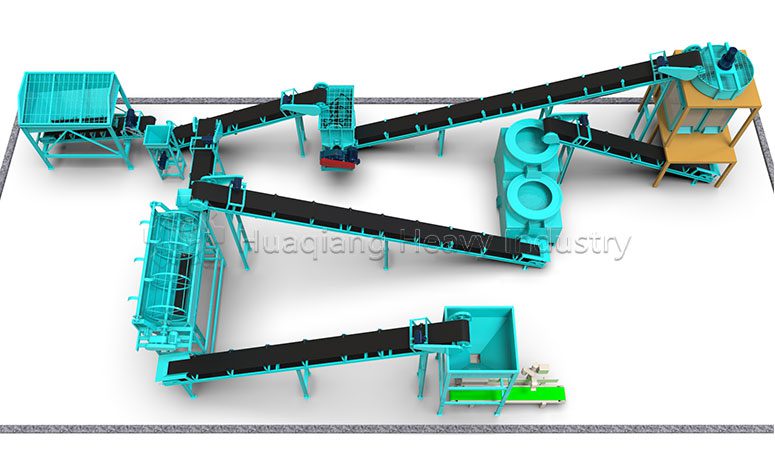
The finished granules have excellent performance and are highly adaptable to modern application scenarios. The roll-formed fertilizer granules have a dense structure and uniform hardness, making them less prone to pulverization and clumping during storage and transportation, suitable for bulk transport and large-scale mechanized fertilization operations. Nutrients are evenly distributed within the granules, resulting in stable release after application without component stratification or fluctuations in fertilizer effectiveness.
Furthermore, the production line is streamlined, lowering the operational and maintenance threshold. The entire line eliminates large supporting units such as drying and cooling systems, requiring less floor space and lower initial infrastructure investment; the equipment is flexible to start and stop, and easy to change materials and clean, adapting to the flexible production needs of multiple varieties; the equipment structure is simple, with few vulnerable parts, resulting in low daily maintenance costs.