

Investors building new fertilizer plants always prioritize overall organic fertilizer production plant cost. Granulation equipment takes up the largest share of total equipment expenditure in the whole production line. Two mainstream granulation systems are commonly used in organic fertilizer factories, namely rotary drum granulation production line and roller press granulator production line. Each set has unique equipment layouts and site requirements, which greatly affect the total investment budget of the whole plant.
The rotary drum granulation production line adopts wet granulation technology for organic fertilizer production. It needs complete auxiliary machines including granulator, dryer, cooler and screener. With more supporting equipment, this line requires larger workshop space and higher power supply standards. The extra infrastructure and device costs will increase the upfront investment part of organic fertilizer production plant cost, matching the operation needs of large-scale continuous fertilizer production.
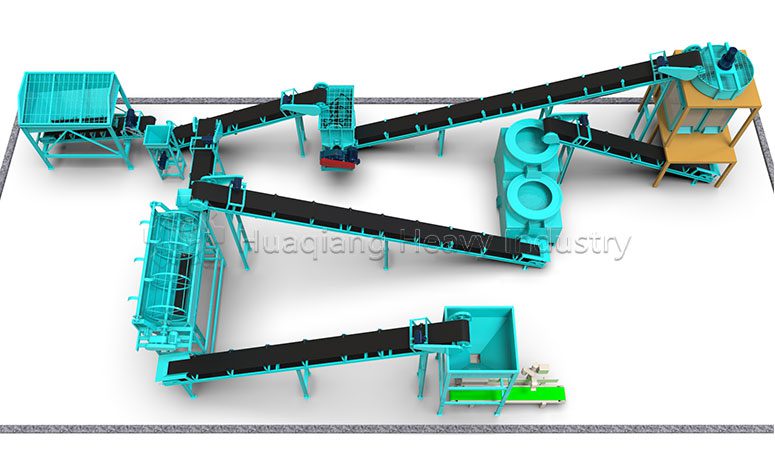
The roller press granulator production line works based on dry extrusion granulation without water adding or drying procedures. It has fewer matched machines and occupies a smaller factory area. This line features lower energy consumption and fewer later maintenance costs, forming a simpler cost structure for organic fertilizer plants. It adapts well to medium and small-scale dry granulation production projects.
Besides granulation systems, total plant investment also includes fermentation equipment, raw material processing devices, workshop construction and daily operating funds. It is necessary to select suitable granulation lines according to actual output goals and production modes.
In conclusion, granulation lines are core factors determining organic fertilizer production plant cost. Both rotary drum granulation production line and roller press granulator production line have their own independent investment compositions. Reasonable selection of granulation equipment based on actual production demands is the key to controlling overall plant investment efficiently.