

A smooth organic fertilizer production line relies on three specialized pieces of equipment working in concert: the crawler-type compost turner, the half-wet material crusher, and the cage crusher. Positioned across the fermentation and crushing stages, their effective coordination ensures the stable output of high-quality granules.
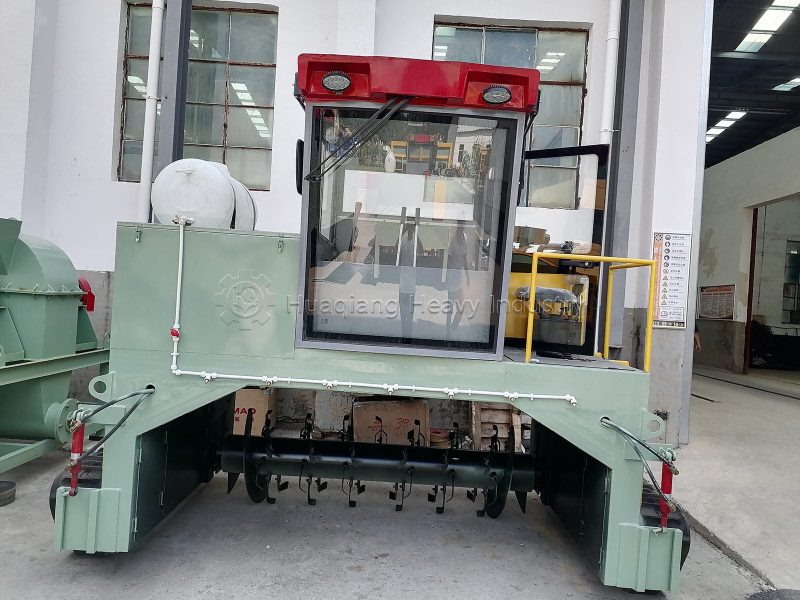
The crawler-type compost turner serves as the “engine” of the fermentation stage. After manure and straw are piled into windrows, the turner—characterized by low ground pressure and stable movement—mixes the pile by turning bottom material to the surface and burying surface material inside, allowing oxygen to penetrate the core. This activates aerobic microorganisms, raising the pile temperature to 55°C–65°C and effectively eliminating pathogens and weed seeds. Typically operated every two to three days, it can shorten the fermentation cycle to 15–20 days.
Once fermentation is complete, the material moves to the crushing stage, where the two crushers work in tandem. The half-wet material crusher handles the first stage of size reduction; post-fermentation material retains a moisture content of 20%–40% and tends to clump, often causing blockages in traditional equipment. This crusher utilizes a screenless design and high-speed hammer impacts to process wet material smoothly, achieving an output fineness of 60–200 mesh with minimal temperature rise, thereby preserving organic matter and residual biological activity.
The cage fertilizer crusher handles fine crushing and the processing of recycled material. Its multi-layer concentric cage-bar rotor employs high-speed impact and shearing forces, making it highly effective at breaking up clumps and cutting through residual long fibers. Particles that remain too coarse after semi-wet crushing, as well as recycled granules, are fed into the cage crusher for reprocessing; this ensures the powdered material entering the granulator is uniform in fineness and free of tangles.
Together, these three machines form a complete pre-processing chain that transforms raw manure into fine powder: the crawler-type compost turning machine ensures uniform fermentation, the half-wet crusher performs coarse crushing of moist material, and the cage crusher handles fine processing and material recycling. When selecting equipment, the processing capacities of the three units should be successively slightly higher than the granulator’s output, and buffer silos should be incorporated to ensure smooth, steady operation of the entire line.