

In organic fertilizer production, granulation is a crucial step determining the product’s appearance and storage/transport performance. Disc granulation technology, with its advantages of simple equipment, controllable granulation, and moderate investment, has become one of the most widely used processes in small and medium-sized organic fertilizer plants. Understanding the core parameters of the disc granulation process and rationally configuring the entire organic fertilizer disc granulation production line is a prerequisite for consistently producing high-quality granules.
The principle of disc granulation is not complex: an inclined circular disc rotates, the material rolls within the disc, and simultaneously, atomized water spray causes fine powder to adhere layer by layer, gradually growing into spherical granules. The size, uniformity, and strength of the granules depend on the coordination of several key parameters.
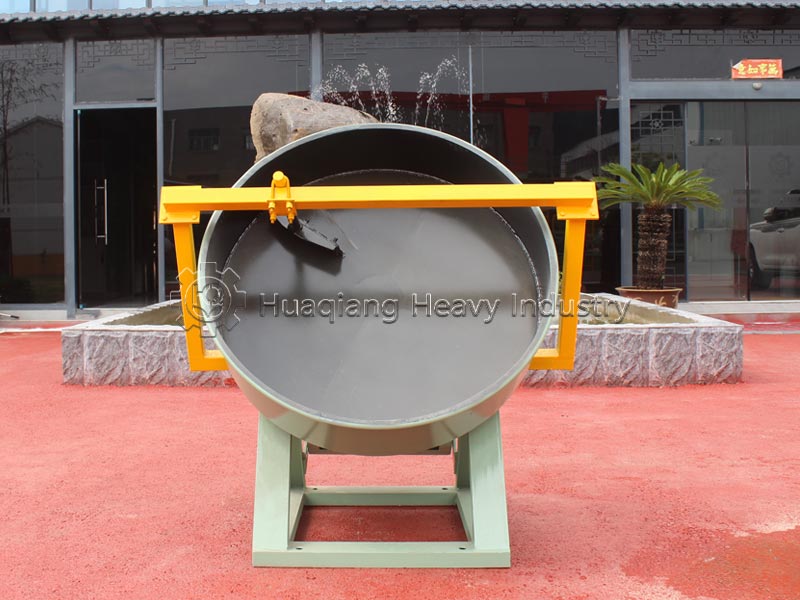
The disc inclination angle is typically between 40° and 55°. A larger angle results in smaller granules, while a smaller angle promotes granule growth. The rotation speed needs to be controlled at 60%-80% of the critical speed; too low a speed will prevent effective rolling, while too high a speed will cause the material to be thrown out. A moisture content of 25%-35% is most suitable. The spray system requires adjustable water volume and uniform atomization, with operators making real-time fine-tuning based on the particle state in the disc.
The entire production line typically includes a crusher, mixer, disc granulator, screening machine, and packaging equipment. The screening process is crucial; qualified particles enter the finished product bin, oversized particles are returned for crushing, and overly fine particles are sent back to the granulation disc via a return conveyor belt for re-granulation, forming a closed-loop cycle with almost no waste.
It is worth mentioning that disc granulation technology is suitable for well-rotted materials with high organic matter content. If the fibers are too long or have large specific gravity differences, crushing and mixing need to be intensified before granulation to improve the pelleting rate. Currently, single-machine output can range from 0.5 tons to 6 tons per hour, and with automatic batching and frequency conversion speed regulation, continuous and stable production can be achieved. For most small and medium-sized organic fertilizer projects, disc granulation production lines are both economical and practical, making them a process route worth prioritizing.