

Organic fertilizer production is a systematic process involving physical, biological, and chemical transformations. Understanding the complete manufacturing process and properly configuring the organic fertilizer production line are essential for consistently producing high-quality products. Throughout this process, the compost turner plays a pivotal role.
The organic fertilizer production process typically consists of six stages. Raw material pretreatment involves mixing livestock manure and crop stalks to achieve the desired carbon-to-nitrogen (C/N) ratio and adjusting the moisture content to 50%–60%. Forced fermentation is a critical step; after the material is piled, a compost turner periodically turns the heap—moving material from the bottom to the surface, breaking up clumps, replenishing oxygen, and dissipating moisture and heat—to maintain aerobic microbial activity over a period of 15–25 days. Following maturation, the material undergoes crushing and mixing, with functional ingredients added; this is followed by granulation (using disc, drum, or extrusion methods), drying and cooling to safe moisture levels, and finally, screening and packaging into commercial fertilizer.
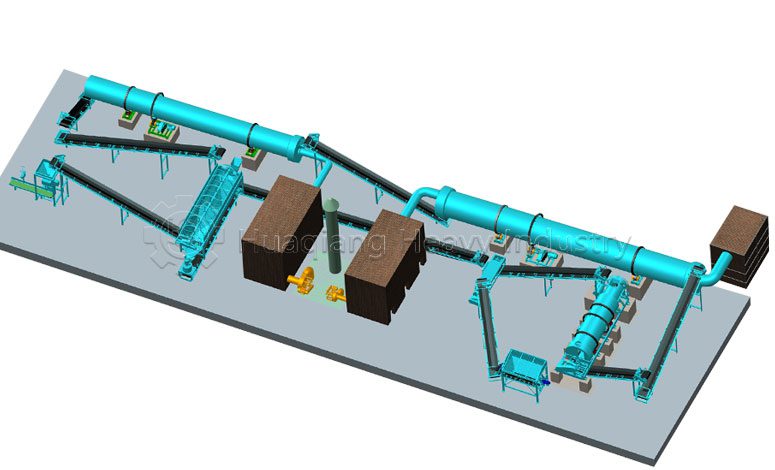
Viewed as a whole, the organic fertilizer compost turning machine is not an isolated piece of equipment; it determines the smooth operation of downstream processes. Uneven fermentation can lead to issues such as crusher blockages, reduced granulation rates, and increased energy consumption during drying. A well-designed production line matches the compost turner’s capacity to the fermentation area and incorporates buffer silos to regulate material flow, ensuring continuous and stable granulation and packaging.
Different production scales require different types of compost turners. Small-scale windrow operations can utilize mobile compost turners, which offer low costs and flexibility, whereas large-scale trough fermentation systems employ rail-mounted or double screws turners that provide greater turning depth and higher efficiency. Equipment selection should be based on material characteristics, the fermentation cycle, and site conditions.
In summary, the organic fertilizer manufacturing process is a chain of operations that begins with turning and concludes with granulation. A reliable compost turner ensures fermentation quality and serves as a prerequisite for the stable operation of the entire production line. Focusing on the initial stages is key to achieving the efficient transformation of waste materials into high-quality organic fertilizer.