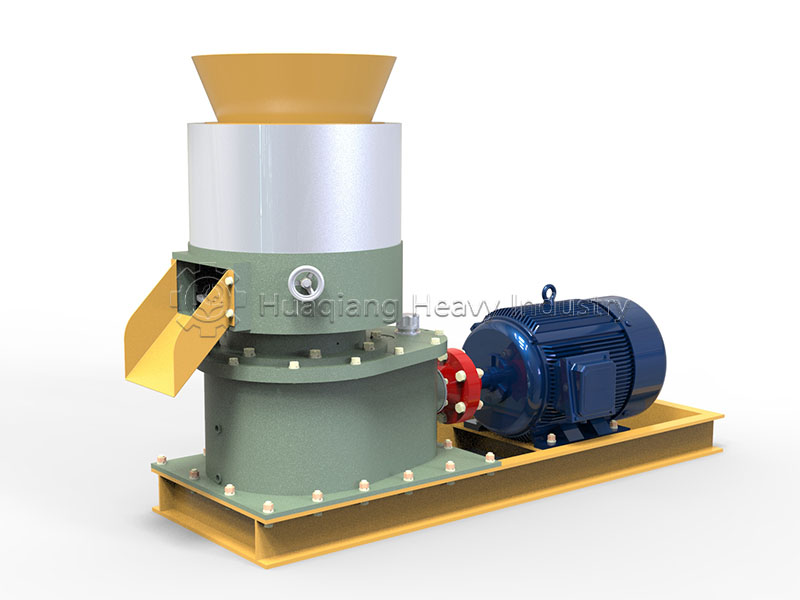
The ring die pelleting machine is a technologically mature and widely used extrusion pelleting equipment in the pelleted feed and organic fertilizer processing industries. The die of the ring die pelleting machine is a vertically installed ring structure. Material is extruded from the inside out after being crushed by the pressure rollers within the ring die cavity. This structural design determines its advantages in terms of production capacity and operational stability—large effective working area, uniform material distribution, and the ability for continuous operation for extended periods. The ring die pelleting machine holds a core position in the feed industry and is the main model for pelleting compound feed and aquatic feed. In recent years, it has also seen increasing application in the large-scale processing of organic fertilizers, performing exceptionally well in processing fibrous materials such as fermented livestock and poultry manure.
Working Principle of Ring Die Pelleting Machine
The ring die pelleting machine completes extrusion pelleting through the combined action of the rotating ring die and the crushing pressure rollers. After being forcibly fed into the inner cavity of the ring die by a screw feeder, the material is evenly distributed into the wedge-shaped area between the inner wall of the ring die and the pressure rollers. The ring die rotates at a uniform speed driven by the main motor, while the pressure rollers, mounted on a fixed eccentric shaft, passively rotate under the frictional force between the inner wall of the ring die and the material. As the ring die rotates, material is continuously drawn into the gap between the pressure roller and the inner wall of the ring die. The pressure roller, like a millstone, crushes and compacts the material, forcibly squeezing it into the densely packed stepped die holes on the ring die wall. The material undergoes compression, densification, and shaping within the die holes, and is continuously extruded from the outer wall of the ring die in a cylindrical strip shape. A fixed or adjustable cutter is installed on the outside of the ring die to cut the extruded strip to a set length, forming uniformly sized cylindrical particles that fall into the discharge port for cooling or screening.
Applicable Raw Materials for Ring Die Pelleting Machine
Ring die pelleting machines are widely used in both the feed and fertilizer industries, and are suitable for a wide variety of materials.
In the feed industry, ring die pelleting machines process most major feed varieties. Compound feed is the most widely used material, including complete compound feeds for pigs, poultry, cattle, and sheep. Concentrated feeds and premixes are easier to transport and use after ring die pelleting. Aquatic feed requires high water resistance in its pellets, and ring die pelleting machine, with its high compression ratio, produces hard pellets with good stability in water. Pet food and feed for special economic animals are also common applications of ring die pelleting machine.
In the organic fertilizer industry, the application of ring die pelleting machines is gradually expanding. Fermented and decomposed livestock manure such as chicken, pig, sheep, and cow manure, after being crushed, is fed into ring die granulation to produce compact and uniform cylindrical organic fertilizer pellets. Agricultural waste such as straw powder, rice husk powder, and sawdust are also suitable for granulation, either alone or mixed with manure. Adding functional microbial agents to bio-organic fertilizer and then extruding it through a ring die at room temperature results in good retention of the microbial agent activity.
In the biomass energy sector, biomass powders such as sawdust, straw, and peanut shells are granulated into pellet fuel using ring die granulation, making it an important equipment option for biomass briquette fuel production.
Basic Raw Material Requirements
Moisture content is a key parameter affecting granulation results. The moisture content of feed materials entering the machine is generally controlled between 12% and 18%. This moisture range ensures the material is fully shaped in the die orifice without causing the pellets to stick and deform after extrusion due to excessive moisture. The moisture content of organic fertilizer materials can be relaxed to 25% to 35%, as fermented materials typically have a natural moisture content within this range and generally do not require additional conditioning. Too low a moisture content results in difficult extrusion, reduced production capacity, and loose pellets; too high a moisture content leads to insufficient pellet strength and easy clumping.
Regarding fineness, feed raw materials generally require at least 80% to pass through a 2-4mm sieve. Uniform fineness is beneficial for pellet formation and surface smoothness. The fineness requirements for organic fertilizer raw materials are relatively relaxed; the maximum particle size should not exceed 8mm, and retaining an appropriate amount of short fibers helps improve pellet strength.
Hard objects such as iron blocks, stones, and bolts must not be mixed into the raw materials. The gap between the ring die and the pressure roller is extremely small; the entry of hard objects will instantly damage the inner wall of the ring die and the die orifice, and may even cause the pressure roller bearing to break. Effective iron removal and screening devices must be installed before feeding.
For low-density, high-fiber materials such as straw and hay, they must be crushed before feeding and the fiber length must be appropriately controlled. Excessively long fibers will affect the uniformity of material distribution within the ring die cavity, leading to blockage of some die holes and uneven capacity distribution.
Production Capacity Range of Ring Die Pelleting Machine
Ring die pelleting machines are available in a full range of specifications, from small feed processing units to large industrial production lines. Users can choose the appropriate model based on their planned output.