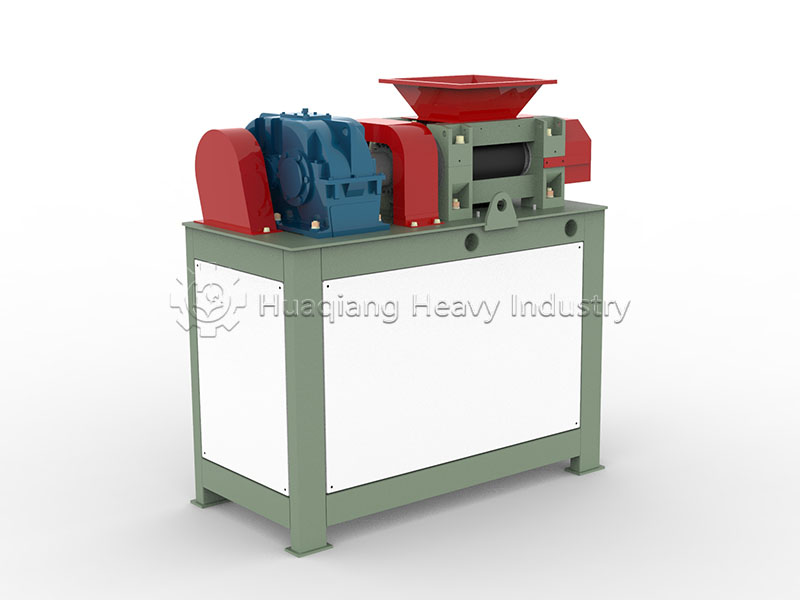
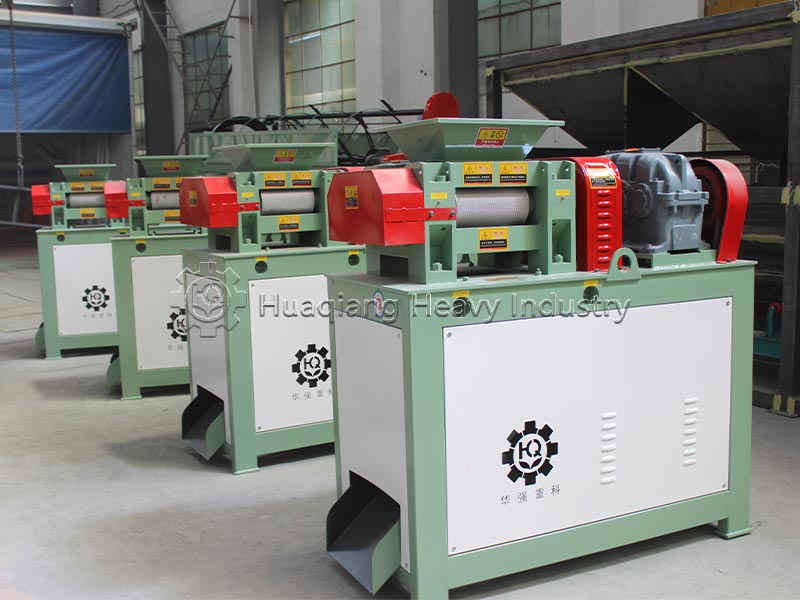
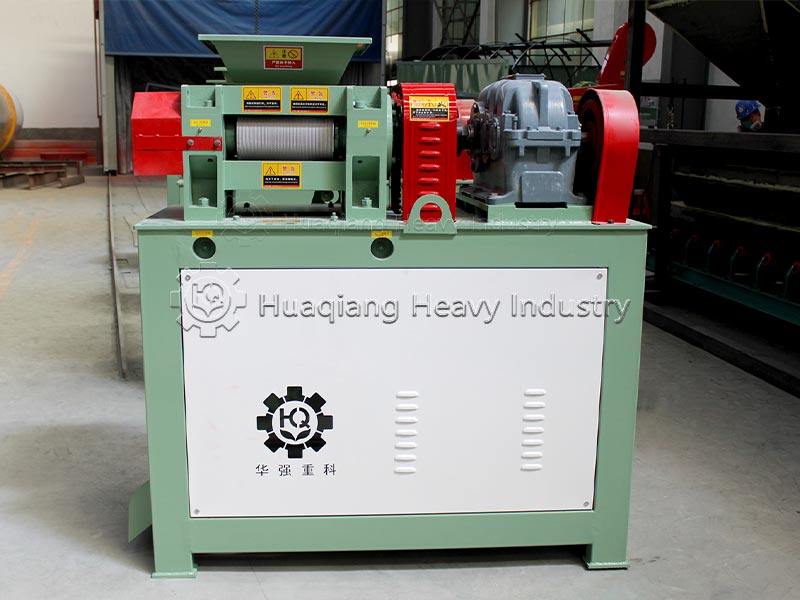
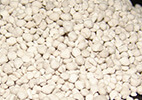
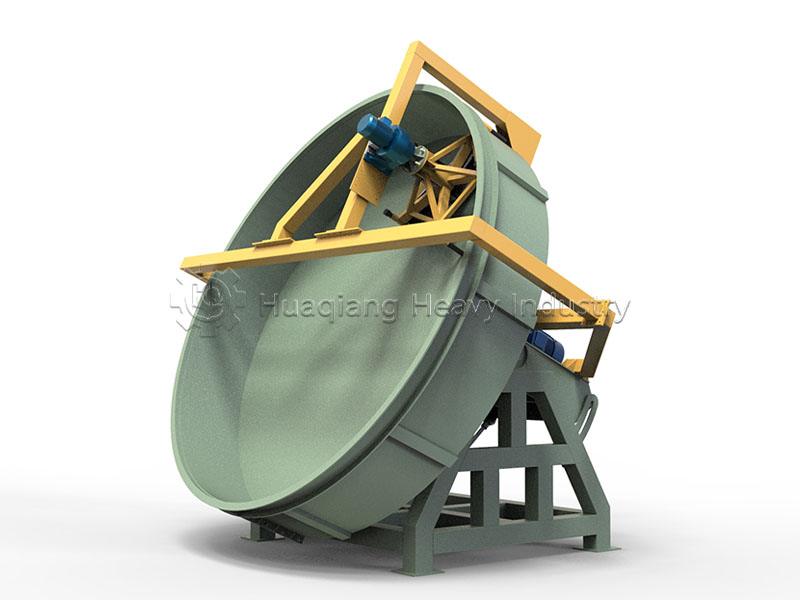
As the name suggests, the double roller press granulator is a machine that compresses powdered material into granules using a pair of rollers. Its operating principle is straightforward: powder enters from the top and falls between two counter-rotating rollers; as the rollers squeeze, the powder is forced into the dense array of pockets on the roller surfaces, forming the granules. The entire process involves no water, heat, or complex chemical reactions, relying solely on direct mechanical pressure. The equipment has a compact footprint and is easy to operate; routine maintenance simply involves cleaning the roller surfaces, changing the hydraulic oil, and periodically lubricating the bearings.
Performance Features of Double Roller Press Granulator
High Wear Resistance and Long Service Life: Key wear parts are made of high-alloy materials, significantly extending replacement intervals and reducing maintenance costs per ton of product.
High Granule Strength: High-pressure extrusion creates tight mechanical interlocking between powder particles, resulting in strong, durable granules that meet downstream application requirements.
Dust-Free and Eco-Friendly: Uses a dry, enclosed granulation process that generates no wastewater; when paired with a dust collection system, it ensures dust emissions meet regulatory standards.
Wide Material Compatibility: Capable of processing various raw materials, such as zinc oxide, calcium chloride, catalysts, desiccants, dust-collector ash, concentrate powder, and ferroalloy powder.
Solutions to Equipment Issues
Several issues commonly arise during actual production, but the solutions are straightforward.
Granules produced from high-nitrogen formulas are too soft. This is usually because raw materials like urea lack sufficient inherent adhesiveness, making it difficult to achieve tight interlocking through pressure alone. Solution: Increase the hydraulic pressure to compact the powder more densely; add 3%–5% bentonite or attapulgite to the formula to enhance binding strength.
Rough or uneven granule surfaces usually indicate insufficient raw material fineness; an excess of coarse particles creates large voids when filling the roller pockets. Control fineness more strictly, aiming for an 80-mesh screen pass rate of over 80%. If fineness is adequate but the surface remains rough, check the roller pockets for wear; severely worn roller shells require replacement.
During the rainy season, materials may absorb moisture; high moisture content makes the material prone to sticking to the rollers and prevents the formation of solid, compact granules. At this stage, the raw material storage silo must be sealed against moisture; if the moisture content exceeds limits, dry powder can be blended in to adjust it. If necessary, a hot-air pre-treatment step can be added at the mixing section to reduce moisture levels beforehand. Additionally, occasional cracking of the roller surface is usually caused by hard foreign objects—such as iron fragments or stones—entering the system; therefore, an iron remover and a vibrating screen must be installed at the feed inlet to intercept hard objects at the source.
Investment Costs for Double Roller Press Granulator
As the core equipment of the dry granulation process, the investment cost for the fertilizer compaction machine is clear and transparent, with no hidden costs. The cost structure for a single unit—from procurement to the start of normal production—is roughly as follows:
Main unit purchase cost: Accounts for 60%–70% of the total investment. Taking the DZJ model as an example, the main unit includes the pressure roller assembly, hydraulic system, drive system, and electrical control system; the price varies depending on the configuration.
Auxiliary equipment cost: Accounts for 15%–20%. This includes the feeding elevator, discharge conveyor belt, screening machine, dust collector, etc. Costs vary based on the level of automation and workshop layout.
Infrastructure and installation costs: Account for 5%–10%. The equipment has a small footprint; including auxiliary equipment and walkways, the entire line occupies approximately 30–50 square meters. The factory building requires no special load-bearing specifications; a standard hardened floor suffices. The installation period is short, allowing for rapid positioning, wiring, and commissioning.
Spare parts inventory cost: Accounts for approximately 5%. It is recommended to stock a set of spare roller shells and commonly used seals initially to ensure quick handling of unexpected production issues.
Transportation and miscellaneous costs: Depending on the distance, these generally account for 3%–5% of the total cost.
Comparison Investment
Wet granulation requires auxiliary equipment such as dryers, coolers, hot-blast stoves, induced draft fans, dust and moisture removal systems, and settling ponds; the total investment for such a line is typically 1.5 to 2 times that of a dry double-roller line.
Wet granulation lines involve extensive civil engineering work—including pouring equipment foundations, constructing furnace bodies, and laying steam piping—resulting in an infrastructure construction period of 1 to 3 months, whereas the infrastructure work for a dry double-roller line is much shorter. Overall, for the same production capacity, opting for a fertilizer roller granulator allows for a reduction of over 30% in initial total investment and shortens the time to production by 70%.