

When constructing an organic fertilizer production line, the choice of granulation equipment directly impacts the product’s physical form and the line’s overall energy consumption. Flat die pelleting machines offer distinct advantages in specific process scenarios due to their dry extrusion method, which eliminates the need for drying. Understanding their role within the overall organic fertilizer production process is far more meaningful than simply comparing prices.
The organic fertilizer production process encompasses stages such as fermentation, crushing, batching, granulation, screening, and packaging. The granulation method determines whether downstream drying and cooling equipment is required, thereby influencing the total investment and energy consumption of the production line. Flat die pelleting machines operate by rolling pressure rollers over a flat die to force material through the die holes, creating cylindrical pellets. The entire process involves no added water or heat; consequently, the moisture content of the output remains essentially the same as that of the input, rendering drying unnecessary.
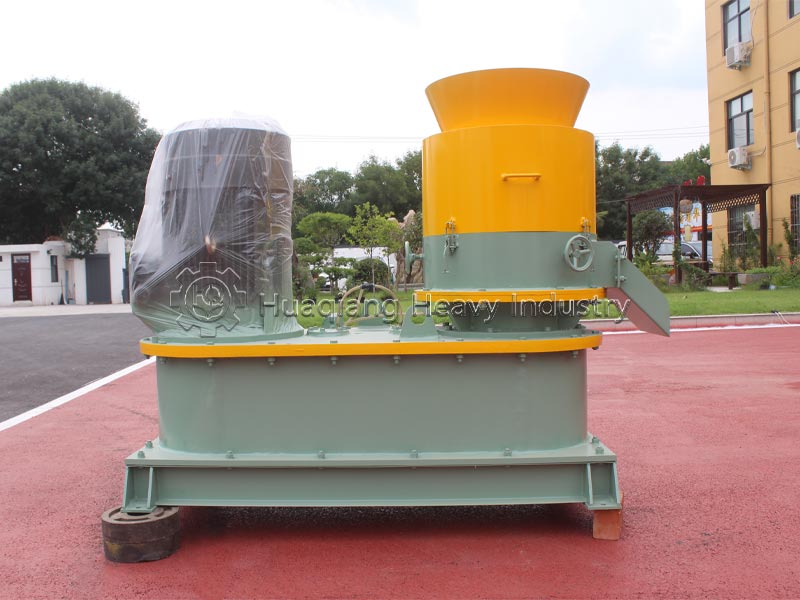
This characteristic makes the flat die pelleting machine ideal for scenarios where the raw material moisture content is already controlled below 20%. If upstream fermentation and air-drying can reduce moisture to this level, the production line can dispense with dryers and coolers, resulting in a streamlined dry-process line consisting solely of crushing, mixing, flat-die granulation, screening, and packaging. This configuration is particularly suitable for regions with high electricity costs or environmental regulations prohibiting the use of coal.
However, flat die pelleting machines have strict requirements regarding the fineness of the input material. If the raw material contains insufficiently crushed fibers or hard particles, the die holes are prone to clogging, leading to reduced output. Therefore, fine crushing and high-efficiency mixing equipment must be employed to ensure the material entering the die is uniform and finely textured.
In summary, provided the raw material has low moisture content and the market accepts cylindrical pellets, a dry-process line centered on a flat die pelleting machine offers low investment and operating costs. Process selection should be based on a rational match between raw materials and market demands, rather than blind adoption of a standard model.