

Large-scale organic fertilizer production lines impose extremely rigorous demands on the stability and capacity-matching capabilities of molding equipment. To effectively integrate into such large-scale operations—thereby guaranteeing both finished product quality and production efficiency—the rotary drum granulator requires precise adjustments across four critical dimensions.
Optimize Rotational Speed and Inclination Angle. When processing high volumes of material, the drum’s rotational speed must be maintained within the range of 18–25 rpm. This ensures the formation of a stable, rolling “material curtain” inside the drum while preventing excessive speeds that could lead to granule fragmentation and increased energy consumption. Additionally, the inclination angle should be set between 2° and 5°, utilizing fine-tuning to effectively extend the material’s residence time within the drum.
Strictly Control Process Parameters. The core objective is to maintain the material’s moisture content within a controlled range of 18% to 25%; moisture levels that are too high can lead to caking, while levels that are too low result in a poor granulation rate. Simultaneously, the binder ratio must be optimized, utilizing quantitative feeding devices to prevent proportional imbalances. Furthermore, the spray angle should be adjusted in tandem to ensure uniform atomization.
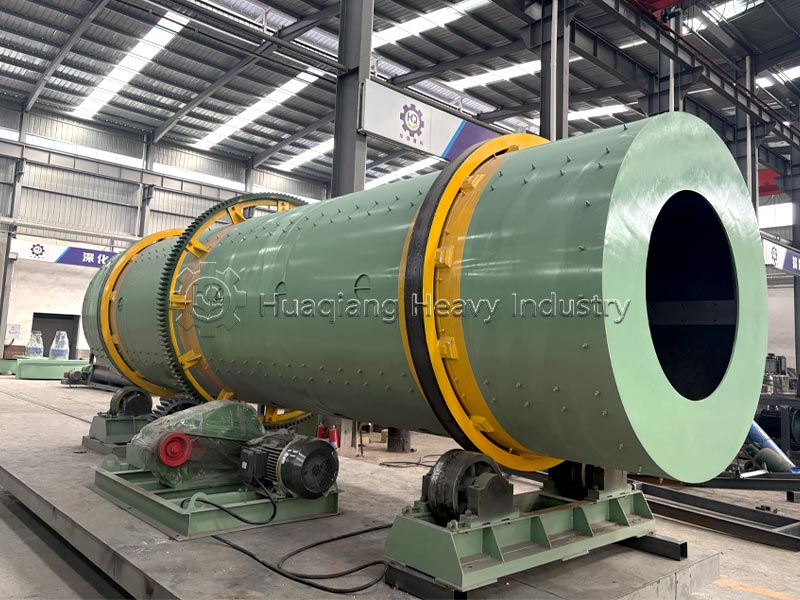
Upgrade Equipment Structure. The feeding system requires upgrading, specifically by enlarging the feed inlet and installing a variable-frequency screw feeder to ensure a uniform and continuous flow of material. The internal structure should also be optimized by replacing internal liners and scrapers with wear-resistant alloy components to minimize material buildup and reduce abrasive wear.
Refine System Linkage and Coordination. The rotary drum granulator must operate in precise coordination with the upstream and downstream equipment in the production line. Upstream, it should be paired with a high-efficiency crushing and mixing machine to ensure uniform raw material particle size. Downstream, it should be configured with large-scale vibrating screens and low-temperature drying equipment to promptly separate and remove substandard granules.
In summary, the key to successfully integrating a rotary drum granulator into a large-scale production line lies in achieving a balance between production capacity and product quality through precise parameter tuning, structural scaling, and integrated system coordination.