

Disc granulation is the mainstream process for organic fertilizer production, producing round, full granules with uniform nutrient distribution. However, many production lines often experience problems such as loose granules, low forming rate, and uneven size. The root cause is mostly in the pre-processing crushing process. As the core pretreatment step in disc granulation, the crushing process, seemingly basic, directly determines the quality of the finished product and production efficiency.
The crushing process in an organic fertilizer disc granulation production line is mainly divided into two stages: raw material pretreatment crushing and post-fermentation re-crushing. In the raw material stage, for various raw materials such as sheep manure, straw, and oil palm fruit bunches, a cage fertilizer crusher is needed to break down coarse fibers and disperse hard lumps, refining the material to a uniform particle size. This avoids coarse fibers blocking subsequent processes and lays the foundation for full fermentation.
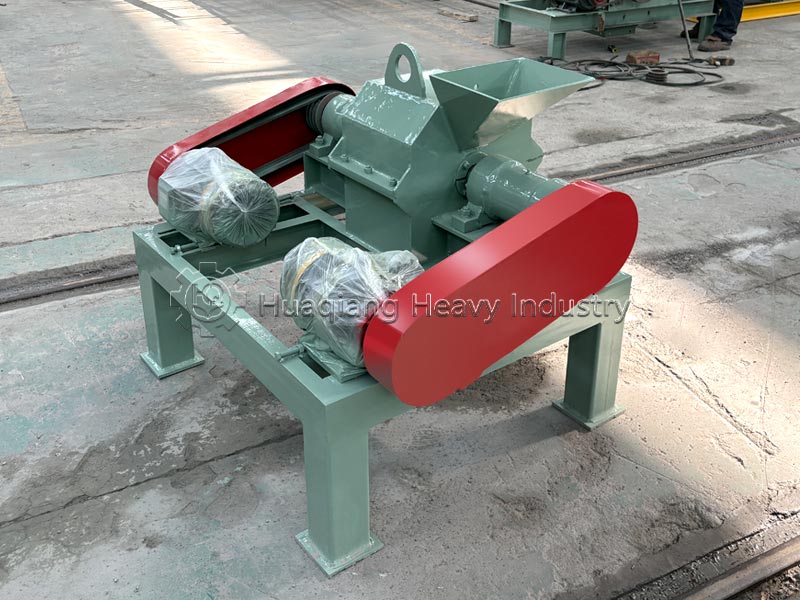
After fermentation and maturation, the material is prone to clumping; secondary crushing is crucial to ensuring granulation quality. At this stage, the clumped fertilizer must be pulverized into a fine, uniform powder, with strict control over particle size standards. If pulverization is incomplete and the material is a mixture of coarse and fine particles, the binding force will be unbalanced after entering the disc granulator, resulting in either difficulty in forming the granules or brittle, rough-looking particles.
Controlling the fineness of the pulverization directly affects the forming rate and finished product quality of the disc granulator. Powder with moderate fineness has stronger binding properties, producing compact, full granules that are less prone to crumbling, and facilitating subsequent drying and packaging.