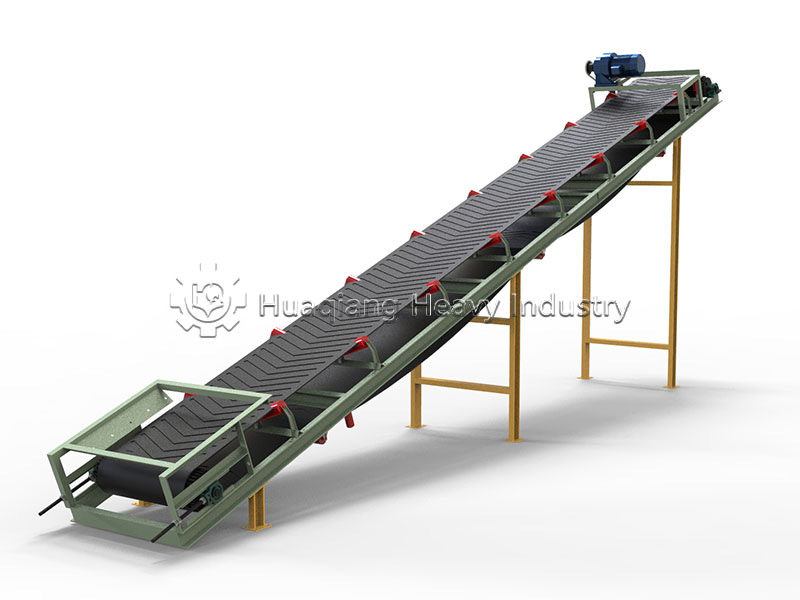
Belt conveyors are among the most durable conveying equipment in fertilizer production. Their simple and robust structure, with core components such as rollers and idlers designed for heavy-duty continuous operation, ensures a service life of over ten years. Even the conveyor belt, the only large-area wear component, can be replaced every few years through proper material selection and routine adjustments. The equipment’s power consumption is relatively low compared to other mechanical conveying methods, requiring minimal maintenance and offering good spare parts compatibility. For fertilizer companies seeking long-term stable operation and reduced maintenance costs per ton of product, belt conveyors are an economical and efficient material handling solution.
Working Principle
The conveyor belt generates traction through the friction of the head drive roller, running along the idler assembly. Material is loaded at the tail end and remains stationary on the carrying section of the conveyor belt. Unloading occurs upon reaching the head end. The conveyor belt tension is maintained constant automatically or manually by a tensioning device. The equipment’s operating speed and conveying capacity can be steplessly adjusted via frequency converter speed regulation of the drive motor to adapt to different production capacity requirements.
Performance Characteristics
Long Lifespan Design: The drive roller uses a large-diameter, thick-walled steel pipe; the idler rollers are sealed for waterproofing and dustproofing, resulting in a long overall lifespan.
Low Operating Resistance: Utilizing the principle of rolling friction, the idler rollers rotate flexibly, consuming less energy than screw and scraper conveyors.
Low Maintenance: With no complex internal components, daily checks only require monitoring idler roller rotation and conveyor belt misalignment.
High Adaptability: Capable of conveying various powdery and granular materials; operating temperature range -20℃ to 40℃; outdoor applications can include rain covers.
Good Environmental Performance: The entire line can be equipped with dust covers and spray dust suppression systems for closed conveying, preventing dust escape.
High Automation: Can integrate protection devices for misalignment, slippage, tearing, and temperature, and can be connected to a central control system.
Maintenance Methods
Daily maintenance focuses on checking the integrity of the conveyor belt joints and for wear and cracks at the edges. Check all idler rollers for flexible rotation; replace any idler rollers that do not rotate immediately to prevent wear through the conveyor belt.
Monthly check the wear of the drive roller’s rubber coating; after polishing the rubber surface, re-coat the rubber. Regularly check the tensioning device to ensure the conveyor belt does not slip during startup and operation.
Change the oil in the speed reducer regularly according to the instruction manual, and add grease to the motor bearings annually. Adjust or replace the scraper blades of the conveyor regularly to maintain good contact with the belt surface. After each heavy rain or prolonged shutdown, remove any accumulated water and material from the conveyor belt before restarting.