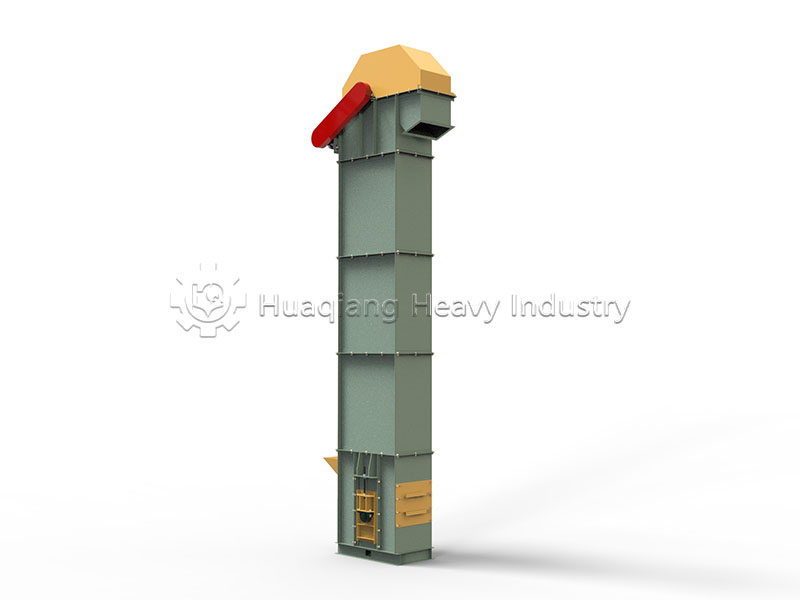
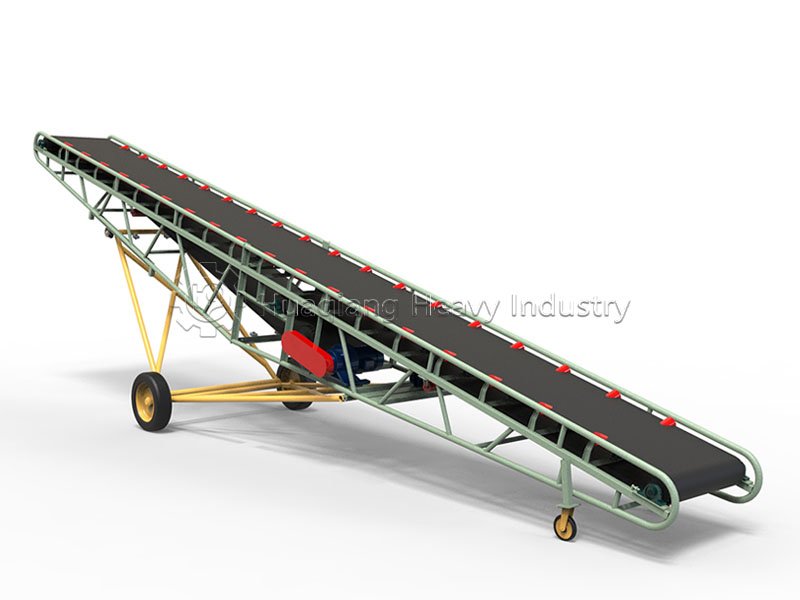
Bucket elevators are core equipment for vertical material transport in organic fertilizer and compound fertilizer production workshops. Fertilizer production lines often arrange granulators, mixers, and packaging machines at different heights due to process requirements. A bucket elevator acts like a continuously operating freight elevator, lifting materials from lower to higher levels. Compared to steep-angle belt conveyors, it occupies less space, and the lifting angle is fixed at vertical or near-vertical. The equipment operates within a sealed casing, preventing material spillage and dust escape, making it crucial equipment for achieving clean production and vertical workshop layout in the organic fertilizer industry.
Working Principle
Material is fed into the bottom inlet of the elevator by the feeding device and falls into the trough of the machine base. The drive unit drives the traction component in a cyclical motion. Buckets fixed to the traction component scoop up material as they pass the bottom or allow it to flow directly into the buckets. Full buckets are lifted to the top, and as they pass the drive wheel, the material is thrown out and discharged through the discharge port. Empty buckets then run down the other side of the cylinder back to the bottom, entering the next loading and lifting cycle. The entire process involves the continuous vertical transport of materials within a closed space.
Equipment Components
Head Containment: Located at the top of the elevator, housing the drive wheel and main shaft bearing housing, with a discharge port and inspection door.
Intermediate Cylinder: Composed of multiple rectangular or circular cross-section cylindrical sections connected by flanges, internally divided into an ascending section and a descending section.
Bottom Base: Located at the bottom of the elevator, housing the idler wheel and tensioning device, with a feed inlet and a cleaning door.
Traction Belt or Chain: For belt-type conveyors, a rubber belt is used with steel hoppers; for chain-type conveyors, a plate chain or circular link chain is used with steel hoppers.
Hoppers: Classified by discharge method. The equipment includes deep hoppers, shallow hoppers, and guide hoppers. Deep hoppers are used for dry, free-flowing materials, while shallow hoppers are used for wet, sticky materials.
Drive Assembly: Motor, reducer, coupling, and drive wheel spindle. Heavy-duty configurations include a hydraulic coupling or frequency converter.
Safety Protection: Equipped with a backstop to prevent accidental reverse rotation, a belt misalignment switch to monitor traction belt operation, and emergency pull rope switches throughout the line.
Operating Precautions
Before starting, check for material buildup or blockage inside the machine casing, ensure the hoppers are not loose or have fallen off, and verify the tension of the traction belt or chain is appropriate. Start under no-load conditions. Feeding should only begin after the equipment is running smoothly; starting with material is strictly prohibited.
Feeding should be uniform and continuous, with the feeder controlling the flow rate to avoid sudden large feeds that could crush the equipment or cause blockages in the machine base. During operation, listen for scraping sounds between the hoppers and the machine casing. If any abnormal sounds are detected, stop the machine immediately for inspection. Never open the maintenance door or observation window while the machine is running.
When stopping, stop feeding first, and only stop the main unit after all material inside the machine has been emptied. Before restarting the equipment after a long period of shutdown, the bottom cleaning door should be opened to remove any hardened material accumulated inside the machine base. When conveying wet and sticky materials, the material adhesion in the hopper should be checked regularly, and the machine should be stopped for cleaning if the adhesion is severe.