

A complete roller press granulation production line relies on more than just the granulator itself to operate effectively. The coordination between stages—ranging from fine crushing of raw materials and extrusion forming to screening and material recycling—directly determines the overall line efficiency and granule quality.
Roller press granulation is a dry extrusion process that imposes strict requirements on feed material fineness. If the raw material contains incompletely crushed particles or lumps, uneven stress distribution occurs on the roller surfaces; this can lead to surface cracks on the granules or, in severe cases, damage to the roller’s molding pockets. Cage fertilizer crushers utilize a “dual-cage counter-rotation” structure, employing high-speed rotating cage bars to subject materials to multi-stage impact crushing, rapidly reducing fertilizer lumps to a fineness of 80–120 mesh. This cage structure offers high crushing efficiency for dry materials (moisture content ≤20%), resists clogging, and produces uniform output particles, making it particularly suitable for pretreating common fertilizer raw materials such as MAP (Monoammonium Phosphate), DAP (Diammonium Phosphate), and urea.
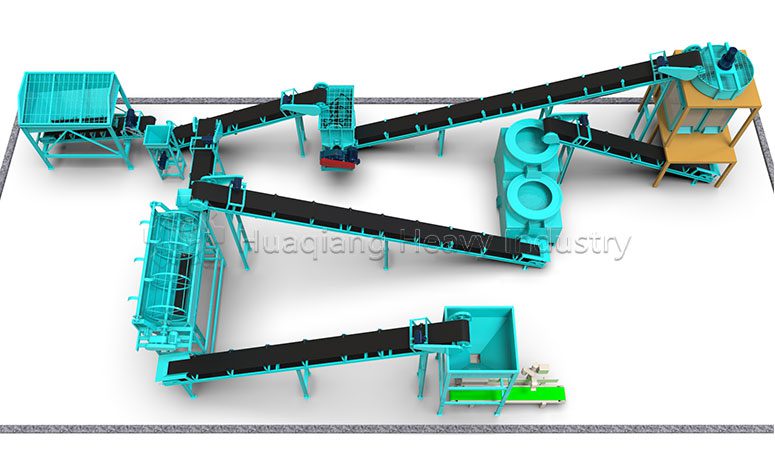
Once crushed to the required fineness, the fine powder is fed into the fertilizer roller granulator via a bucket elevator and a forced feeding system. Two counter-rotating, high-strength rollers compress the material into dense sheets under pressures of 10–30 MPa. This process requires no water, binders, or hot-air drying, characterizing it as a typical dry, ambient-temperature process. After the sheets undergo crushing, granulation, and vibrating screening to yield qualified granules, the undersized fines are returned via a sealed conveyor belt to the feed hopper at the granulator’s inlet for re-extrusion, thereby achieving a closed-loop material cycle.
In practical operation, the crushing efficiency of the cage crusher, combined with the extrusion pressure and roller surface material of the roller granulator, determines the production line’s total output and granule quality. Substandard crushing fineness reduces granulator output, while insufficient pressure results in inadequate granule strength and a lower finished product yield. When planning a roller press granulation line, it is essential to focus on the technical compatibility between the upstream crushing equipment and the core forming equipment, rather than evaluating the performance of individual machines in isolation.