

The disc granulation production line centers on a tilting, rotating disc. Through physical rolling and liquid-phase bridging, it aggregates powder into uniform granules, offering both flexibility and economy throughout the process.
After crushing and mixing, the raw materials are evenly fed onto the disc surface by a feeder. The disc is tilted at a specific angle, and its rotation generates centrifugal force and friction, lifting the powder to a higher position before it naturally rolls back down, forming a continuous curtain of material. Simultaneously, atomizing nozzles finely spray water, steam, or binder solution onto the tumbling powder surface. The moistened fine powder adheres to each other during rolling, growing layer by layer like a snowball.
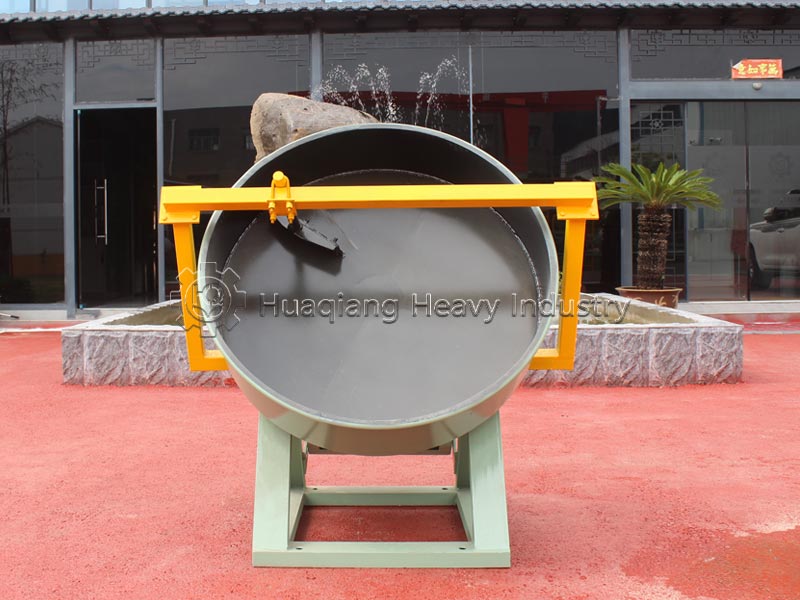
During granulation, the particles within the disc naturally stratify: fine powder is continuously added to the bottom of the disc, providing raw materials for the growing granules; larger particles near the edge of the disc automatically overflow due to centrifugal force. The operator controls the roundness and density of the granules by adjusting the disc’s tilt angle and rotation speed—too large an angle results in material splashing, while too small an angle leads to overly compacted granules; experience and real-time observation are both essential. Semi-finished products overflowing from the granulator are screened; qualified granules enter the drying, cooling, and coating processes. Unqualified granules that are too fine or too large are returned to the disc granulation process via a return conveyor belt, mixed with new raw materials, and re-participated in granulation, achieving a closed-loop material cycle with virtually no waste discharge.
Disc granulation technology does not require high temperature and pressure; it relies solely on physical force and a suitable liquid phase for granulation. It is well-suited for compound fertilizers, organic fertilizers, and mineral microspheres. Furthermore, the equipment is simple and energy-efficient, making it a widely used green granulation solution in small and medium-scale production lines.