

The organic fertilizer manufacturing process typically encompasses stages such as raw material pretreatment, aerobic fermentation, crushing and screening, batching and mixing, granulation, and packaging and storage. Within this chain, the windrow compost turner plays a central role during the fermentation phase, directly influencing the operational quality of all subsequent processes.
Raw material pretreatment is the initial step. Livestock manure typically has a moisture content of 60%–80%; solid-liquid separation is required to reduce this to 60%–65%. Bulking agents, such as crop stalks, are crushed to lengths of 2–5 cm and mixed with the manure, then piled into windrows measuring 2–6 meters in width and 1–2 meters in height.
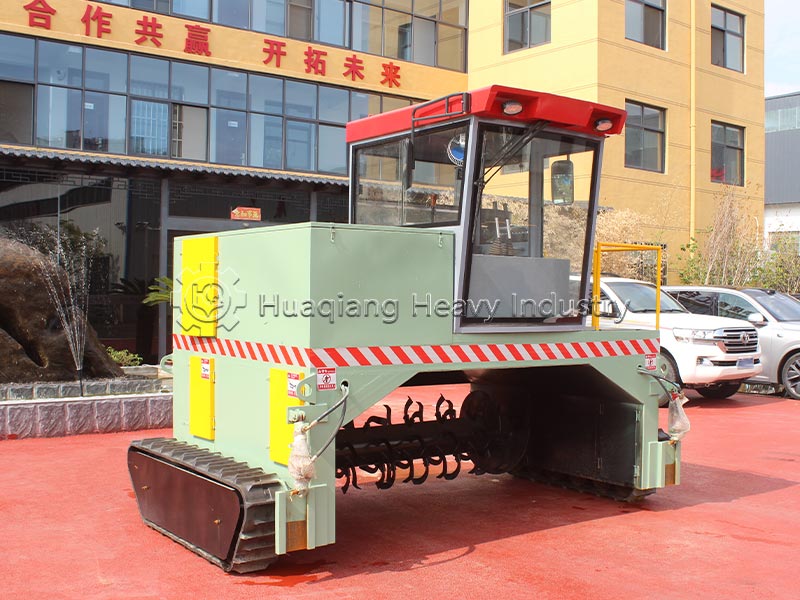
The windrow compost making machine is specialized equipment designed specifically for this scenario. It travels slowly along the windrow, using a rotating drum equipped with high-speed paddles or tines to lift material from the bottom to the surface, breaking up clumps and remixing the contents. This action achieves three objectives: introducing oxygen into the pile, releasing exhaust gases, water vapor, and excess heat, and promoting uniformity in the pile’s temperature and moisture levels.
Once decomposed, the material proceeds to post-processing stages: crushing and loosening, screening to remove impurities, and—depending on the specific product—granulation, drying, cooling, and packaging. Although the windrow compost turner operates at the beginning of the process, the quality of the material it processes—specifically the uniformity of decomposition and moisture stability—directly impacts the load on crushers, the granulation rate, and energy consumption during drying.
In summary, the organic fertilizer production process is a comprehensive chain that begins with turning and concludes with granulation. A suitable windrow compost turner ensures high-quality fermentation, laying the foundation for the stable operation of the entire production line.