

Many organic fertilizer manufacturers mistakenly believe that the output of a bio-organic fertilizer production line is solely determined by equipment specifications. In reality, because bio-organic fertilizer contains active microorganisms, its production process is more specialized, and the finished product output is constrained by multiple conditions.
Raw material conditions are the fundamental prerequisite for production capacity. Bio-organic fertilizer has strict requirements for the moisture content and carbon-nitrogen ratio of raw materials. Abnormal humidity and imbalanced ratios will inhibit microbial activity and slow down fermentation. Inadequate pretreatment of raw materials can easily lead to material caking, fermentation stagnation, or even spoilage.
Fermentation and maturation efficiency is the core bottleneck to production capacity. Bio-organic fertilizer production requires ensuring the survival of microorganisms and the full maturation of materials. Site temperature and humidity, as well as the frequency of turning and oxygen supply, directly affect the fermentation cycle. Low efficiency and prolonged fermentation cycles will severely limit the output of the entire production line.
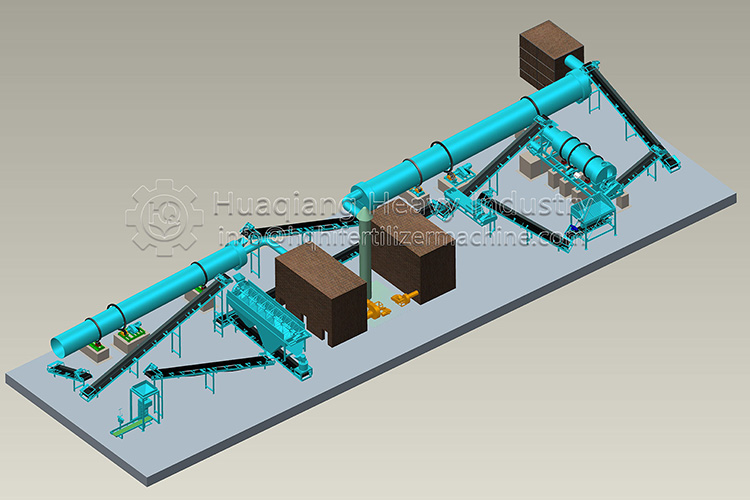
The matching degree of the entire equipment line determines the smoothness of production. A bio-organic fertilizer production line is a linked system, and the capacity of each piece of equipment must be balanced and adapted. If the capacity of upstream and downstream equipment is mismatched, or if there are bottlenecks in the process flow, it will create a bottleneck in production capacity, leading to idle equipment, insufficient material supply, and a decrease in overall production efficiency.
Standardized process control is also indispensable. Improper control over the proportion of microbial agents, the uniformity of mixing, and drying can cause problems such as inactivation of microorganisms, substandard finished products, and increased rework rates, significantly reducing the yield of high-quality products.
In summary, the production capacity of a bio-organic fertilizer production line is a systemic achievement. Only through simultaneous optimization can capacity limitations be overcome, and stable and high-yield production achieved.