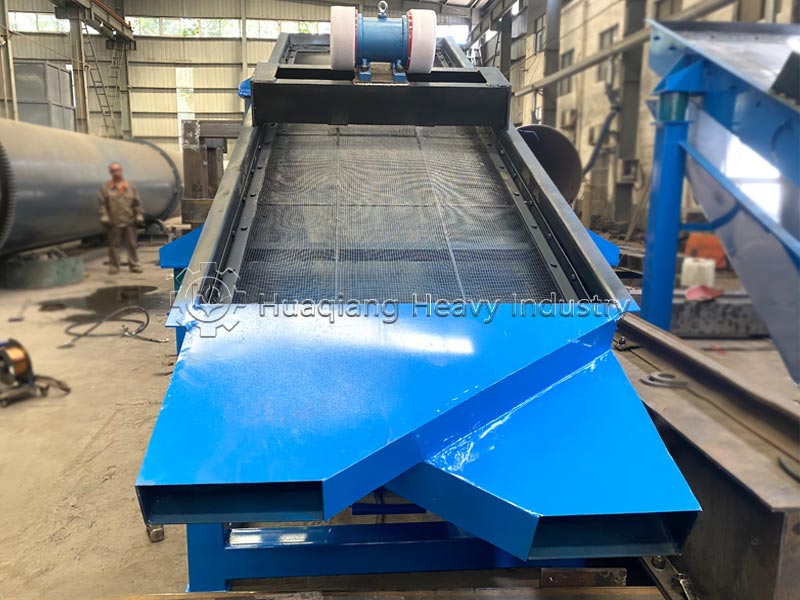
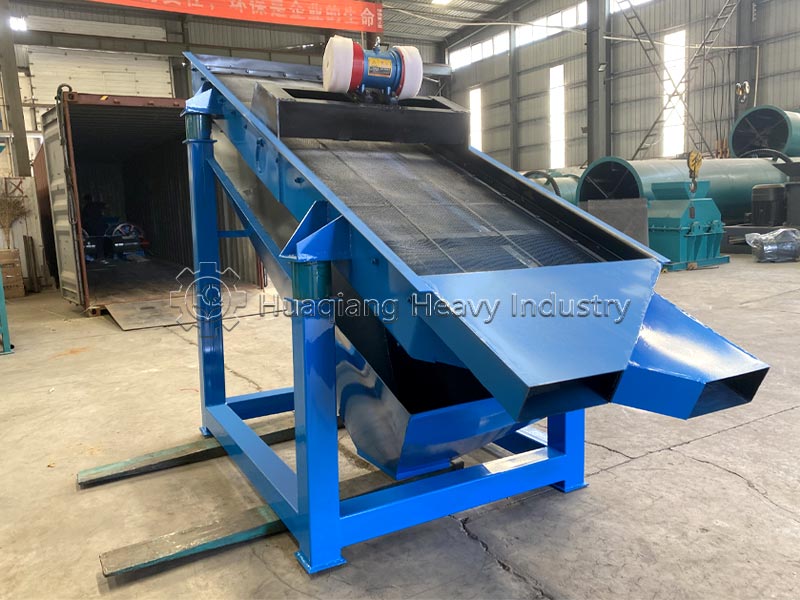
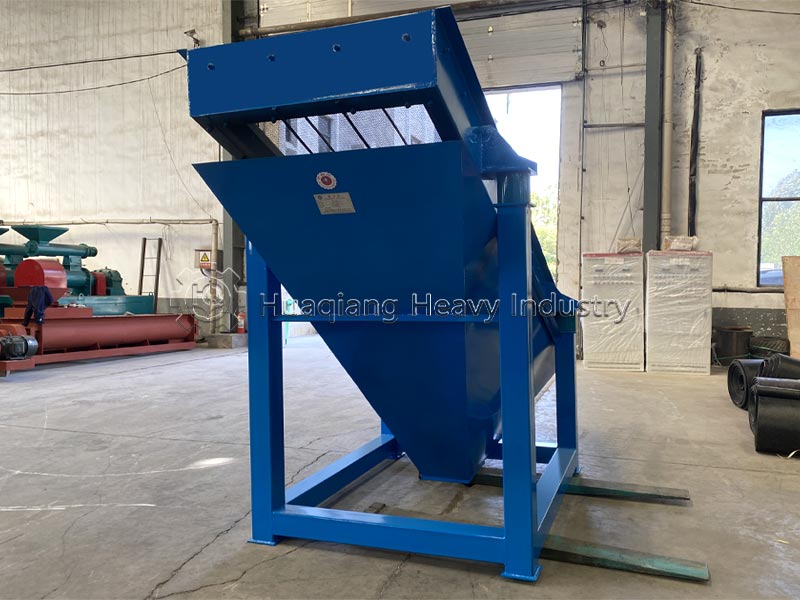
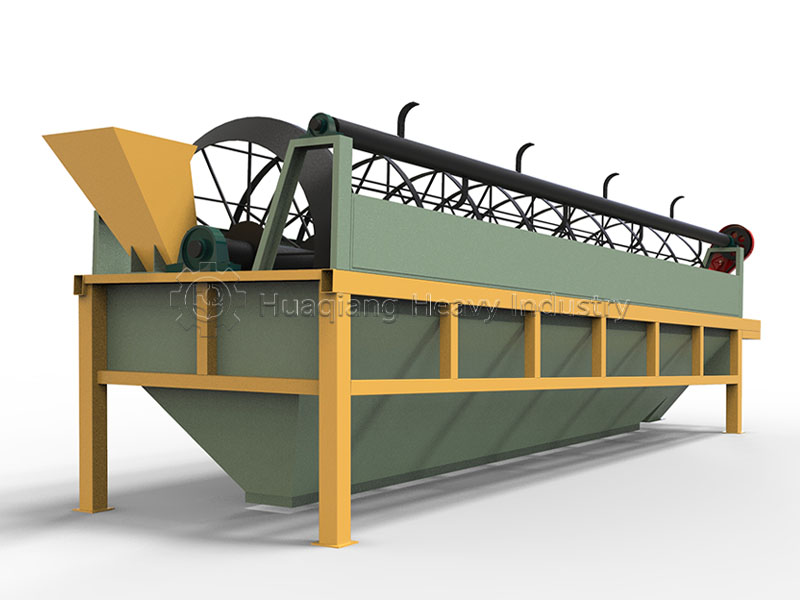
Vibration screener machines are typically installed in organic fertilizer and compound fertilizer production lines after cooling and before packaging, responsible for removing dust and finely grading the finished granules. Even after drum screener machine, the finished granules may still contain a small amount of fine powder and broken particles. Direct packaging, handling, and storage will generate dust, affecting the user experience. As the core equipment in the fine screening section, the vibrating screen thoroughly removes fine powder and broken particles through high-frequency vibration, resulting in clean, uniformly sized finished granules, improving product quality and market competitiveness.
Working Principle
Material enters the screen surface through the feed inlet. The vibrating motor drives the screen box to perform directional high-frequency vibration. Under the action of vibration, the material is continuously thrown up and forward. Fine powder and broken particles jump across the screen surface and fall through the screen holes into the lower collection hopper, while qualified particles advance along the screen surface and exit from the discharge end. The multi-layer screen structure can simultaneously separate fine powder, qualified particles, and oversized particles, which then enter different conveying channels. The vibration intensity and screen inclination angle are adjustable to adapt to different materials and output requirements.
Process Advantages
Excellent dust removal effect, clean finished particles, dust-free packaging, and a superior user experience.
Moderate processing capacity, suitable for fine screening in the later stages of the production line, without causing particle breakage.
Compact equipment with minimal footprint, allowing for flexible placement before the packaging section.
Can be integrated with a dust removal system, achieving zero dust emissions and environmental friendliness.
Selection Methods
The screen surface area is determined based on the processing capacity and material characteristics; the larger the processing capacity, the larger the screen surface area.
The number of screen layers is selected based on grading requirements; generally, two layers are sufficient for both dust removal and grading.
The screen aperture is determined based on the lower limit of the finished particle size to ensure sufficient passage of fine powder.
The power and excitation force of the vibrating motor are calculated based on the screen surface area and material bulk density; appropriate margins should be allowed during selection.
A buffer and equalization device should be installed at the feed end to ensure uniform material entry into the screen surface.
The adjustable range of the screen body inclination angle is generally 0~10 degrees, selected according to the material flowability. Polyurethane screens are recommended for organic fertilizer materials as they are wear-resistant and less prone to clogging; stainless steel woven mesh can be used for compound fertilizer granules.