

In the wave of green agriculture, bio-organic fertilizer, with its dual advantages of “nutrients + functional microorganisms,” has become a powerful tool for improving soil and suppressing diseases. Unlike ordinary organic fertilizer, the core of bio-organic fertilizer lies in the introduction and retention of active functional microorganisms, which places higher demands on the process design of the entire bio-organic fertilizer equipment.
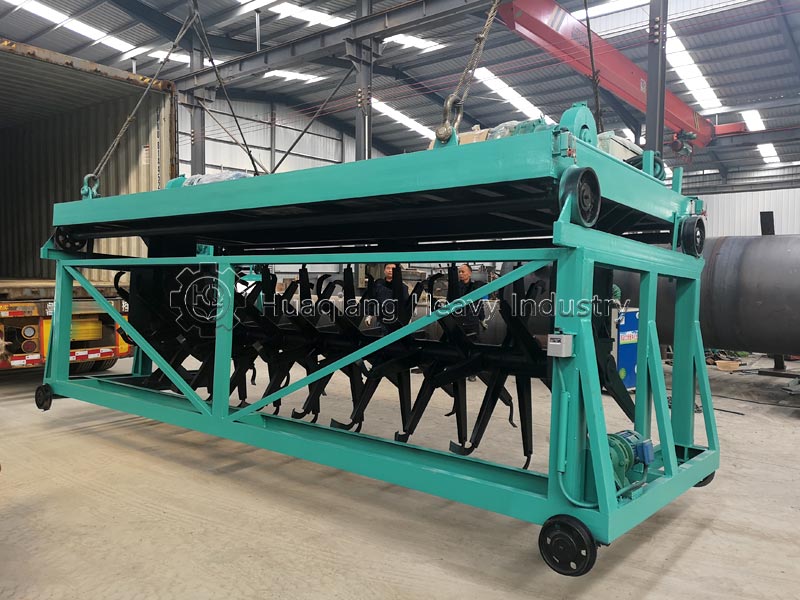
The base of bio-organic fertilizer also needs to undergo high-temperature composting to kill pathogens and weed seeds. During this stage, equipment such as trough-type compost turning machines play a crucial role, converting livestock manure, straw, etc., into stable and harmless organic materials through regular oxygen supply. It is worth noting that the high-temperature sterilization process at the front end is not the time for adding conventional functional microorganisms.
After the composted material cools to room temperature, the critical step in bio-organic fertilizer production—microbial agent compounding—begins. At this point, a dedicated microbial agent additive machine becomes the “heart” of the entire bio-organic fertilizer production line. Functional microorganisms cannot withstand high temperatures and must be evenly mixed in after the material temperature has dropped to a suitable range. Precise control at this stage directly determines the number of viable bacteria in the finished product.
To protect microbial activity, subsequent processing must avoid high temperatures and intense compression. In the granulation stage, many production lines opt for physical rolling molding to minimize damage to the microorganisms. If a drying process is used, low-temperature drying equipment must be employed to strictly control the temperature within the range tolerable by the microorganisms.
The entire production line achieves automated flow from composted raw materials to functional granules. Through the scientific configuration of these bio-organic fertilizer devices, the resource utilization of waste is realized, and the fertilizer is given the “vitality” to improve the soil.