

A complete roller press granulator production line relies on more than just the granulator itself to produce high-quality output. While the fertilizer roller granulator serves as the core forming unit responsible for the extrusion process, the upstream cage fertilizer crusher supplies the necessary finely powdered raw material; together, they form the critical stages of the production line.
Roller press granulation is a dry extrusion process that imposes strict requirements on feed fineness. If the raw material contains incompletely crushed particles or agglomerates, uneven pressure distribution occurs on the roller surfaces; this can lead to surface cracks on the granules or, in severe cases, damage to the roller’s molding pockets. The cage crusher employs high-speed rotating cage bars to subject the material to multi-stage impact crushing, rapidly reducing agglomerated fertilizer raw materials to a fine powder (finer than 80 mesh). Compared to hammer mills, the cage structure generates less heat, minimizes material adhesion, and ensures uniform output particle size, thereby providing ideal feed conditions for the granulator.
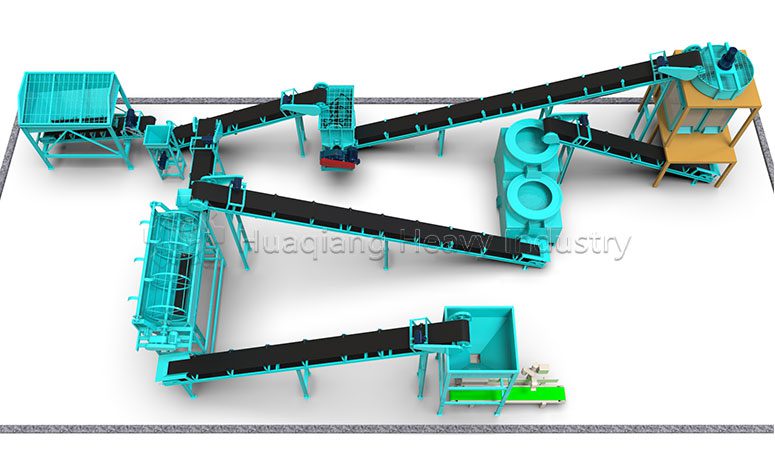
The properly crushed fine powder enters the fertilizer roller granulator via a forced feeding system. Two counter-rotating, high-strength rollers compress the material into dense sheets, which are subsequently broken down, granulated, and screened to yield the final product. The entire process requires no water or steam—eliminating the need for a drying stage—resulting in significantly lower energy consumption and equipment requirements compared to wet granulation processes.
The material recirculation system is another crucial component of the line. Oversized or undersized material (specifically, fines recovered after screening) is returned via a sealed conveyor to the feed hopper upstream of the granulator for re-extrusion, creating a closed-loop cycle. This setup requires the crusher’s throughput capacity to slightly exceed the granulator’s demand, while the granulator’s output must be balanced with the capacity of the downstream screening and packaging units.
In actual operation, the crushing efficiency of the cage crusher, combined with the double roller press granulator’s operating pressure and roller surface material, determines the line’s overall output and granule quality. Insufficient crushing fineness reduces granulator output, while inadequate pressure results in low granule strength and a reduced product yield. Consequently, system planning must focus on matching the technical parameters of the upstream crushing and forming equipment, rather than evaluating the performance of individual machines in isolation.